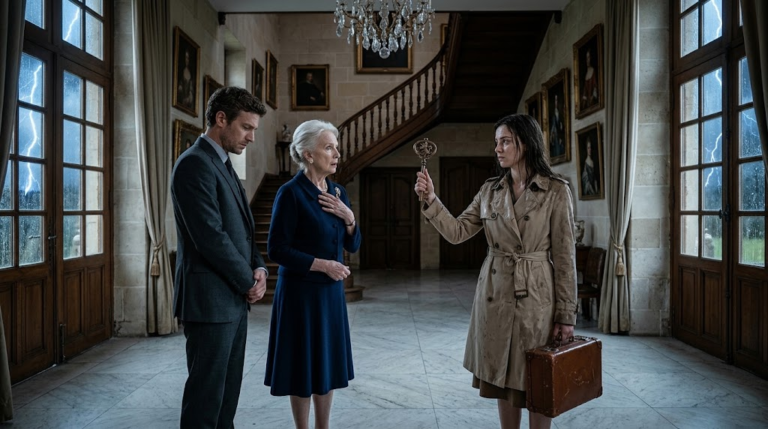
My daughter-in-law pointed at my two-hundred-thousand-dollar retirement savings and called it “free money.”
My son stood beside her.
He said nothing.
Two hours after I told them no, someone tried to access my bank account.
That was the moment I stopped thinking we were having a family disagreement.
And started wondering whether someone had already decided my money belonged to them.
Rain tapped steadily against the windows of my Seattle home that afternoon.
Soft.
Persistent.
The kind of rain that made the house feel smaller and quieter than usual.
I was standing in the kitchen making tea when the front door opened.
No knock.
No phone call.
Julian simply walked in.
His wife, Clara, followed behind him wearing a rain-darkened coat and carrying a glossy real-estate brochure.
I looked at them.
“You could have called.”
Clara barely acknowledged the comment.
She walked straight to my kitchen counter and placed the brochure in front of me.
Bellevue.
New construction.
Large windows.
Stone exterior.
Designer kitchen.
A backyard overlooking the hills.
Everything polished enough to make the price feel almost secondary.
Clara flattened the brochure with one palm.
“Nora, we’ve come to a decision.”
I looked at Julian.
He was standing behind her.
Hands in his coat pockets.
Eyes lowered.
I turned back to Clara.
“A decision about what?”
“This house.”
She tapped the photograph.
“It’s perfect for us.”
“For you.”
“Yes.”
A small pause.
“We only need the down payment.”
There it was.
I looked down.
A number had been circled near the bottom.
$200,000.
I read it once.
Then again.
Two hundred thousand dollars.
The exact amount sitting in the savings account my late husband and I had spent decades building.
Not extra money.
Not spending money.
Not an inheritance waiting to be claimed.
My retirement.
My safety net.
My freedom.
I looked at Clara.
“It’s a beautiful property.”
Her expression brightened.
“But how are you planning to pay for it?”
The brightness disappeared.
She smiled awkwardly.
“We’re not expecting to pay for everything ourselves.”
I glanced at my son.
He still wouldn’t look at me.
Clara continued.
“You have money sitting in savings doing absolutely nothing.”
I said nothing.
She leaned closer.
“It’s idle cash, Nora.”
Idle cash.
Those words stayed in the air.
My husband, Samuel, and I had started saving when Julian was still in elementary school.
A little at a time.
Some months fifty dollars.
Some months nothing.
Later, when our income improved, we saved more.
We skipped vacations.
Delayed buying new cars.
Cooked at home.
Paid down debt.
Samuel used to joke that retirement savings grew like trees.
Slowly enough that you became impatient.
Then suddenly enough that one day there was shade.
When Samuel died, that account became more than savings.
It became security.
It meant I could remain independent.
It meant I would never have to ask my son for permission to repair my roof.
Never have to choose between medication and groceries.
Never have to move into someone else’s house because I had run out of options.
Clara saw none of that.
She saw a number.
“You’re family,” she said.
“I know.”
“Julian is your only heir.”
I looked at my son.
His jaw tightened.
Clara continued.
“So why should we wait?”
That sentence changed something inside me.
Why should we wait?
Not:
Could you help us?
Not:
Would you consider a loan?
Not:
How much can you comfortably afford?
Why should we wait?
As though my death were simply an inconvenient delay in their financial plans.
I picked up my tea.
It was too hot to drink.
I set it back down.
“My answer is no.”
Clara blinked.
“What?”
“No.”
Her eyebrows rose.
“You haven’t even thought about it.”
“I have.”
“For thirty seconds.”
“For thirty years.”
Julian finally looked up.
“Mom…”
I turned toward him.
He hesitated.
Then said:
“Maybe just hear her out.”
That hurt more than Clara’s entitlement.
He knew what that money meant.
He had watched his father save.
He had watched us make sacrifices.
He had watched Samuel spend his final months worrying about whether I would be financially secure.
And now Julian stood in my kitchen asking me to “hear her out” while his wife treated my retirement savings like an advance on his inheritance.
Clara folded her arms.
“We’re not asking you to throw it away.”
“No.”
“You’d be helping your family.”
“I help my family.”
“Then why is this different?”
“Because you’re asking me to risk my retirement so you can purchase a house you cannot currently afford.”
Her face hardened.
“That’s unfair.”
“No.”
I kept my voice calm.
“It’s accurate.”
Julian shifted his weight.
“Mom, nobody said you’d lose everything.”
I pointed at the brochure.
“That number is almost my entire liquid savings balance.”
He went still.
I noticed it.
That reaction.
That hesitation.
Then Clara answered too quickly.
“You’ve mentioned the amount before.”
Had I?
Maybe.
Years ago.
I couldn’t remember.
But suddenly I was very aware that they knew the number almost exactly.
Clara pushed the brochure toward me.
“We would pay you back.”
“When?”
“Once things stabilize.”
“What does that mean?”
She frowned.
“You’re making this adversarial.”
“I’m asking a basic question.”
Julian sighed.
“We can work out terms.”
“Then go to a bank.”
Silence.
That answer irritated Clara more than anything else.
She pulled the brochure back.
“You know the bank won’t approve us for enough.”
“Then perhaps the house isn’t affordable.”
Her face hardened.
“So that’s it?”
“Yes.”
“You’re going to sit on two hundred thousand dollars while your own son struggles?”
I looked at Julian.
He said nothing.
Again.
That silence told me everything.
I picked up my tea.
“This conversation is over.”
Clara stared at me.
Then shoved the brochure into her bag.
“Fine.”
Julian followed her toward the door.
Before leaving, he turned.
“Mom.”
I waited.
He looked as though he might finally say something that mattered.
Instead, he said:
“You could have handled that better.”
Then he left.
The door closed.
The house became quiet again.
Rain against glass.
Kettle cooling.
Nothing else.
I stood in the kitchen for a long time.
Then I folded the brochure and placed it in a drawer.
Not because I wanted it.
Because something about the conversation bothered me.
The exact amount.
Their certainty.
The assumption.
I told myself I was overthinking it.
Two hours later, my phone buzzed.
BANK SECURITY ALERT.
I almost ignored it.
Then I opened the notification.
UNRECOGNIZED LOGIN ATTEMPT.
My stomach tightened.
I tapped the alert.
Another message appeared.
PASSWORD RESET REQUESTED.
I stopped breathing for a second.
Nobody should have been trying to reset my banking password.
I had not forgotten it.
I had not requested anything.
I called the bank immediately.
The representative verified my identity.
Then said:
“Yes, Mrs. Bennett. I can see the attempted login.”
“Was anyone successful?”
“No.”
“Was a transfer initiated?”
“Not successfully.”
Not successfully.
The phrase chilled me.
“What does that mean?”
“There appears to have been an attempt to access transfer functions after the password reset process began, but our authentication controls stopped it.”
I sat down.
“How much?”
“I cannot confirm an initiated amount because access was blocked before completion.”
My eyes moved toward the drawer.
The Bellevue brochure was still inside.
$200,000.
Exactly what Clara wanted.
Two hours earlier, she had called it idle cash.
Now someone had tried to access the account where it was sitting.
Maybe it was a coincidence.
Maybe it wasn’t.
I asked the representative:
“Can you preserve the access logs and device information?”
“Yes.”
“I want every detail preserved.”
“Absolutely.”
“I also want online transfers frozen until I personally authorize them.”
“We can place enhanced restrictions on the account.”
“Do it.”
“Would you like us to revoke all trusted devices?”
“All of them.”
I changed the password.
Changed the security questions.
Added additional authentication.
Removed every previously trusted device.
Then I sat in silence.
I didn’t call Julian.
I didn’t call Clara.
Because an accusation without proof is just noise.
And I had learned something important over sixty-six years.
When people expect you to react emotionally, calm becomes powerful.
I opened the drawer.
Removed the Bellevue brochure.
Placed it beside my phone.
Then looked again at the circled number.
$200,000.
I stared at it for almost a minute.
Then I noticed something I hadn’t seen before.
In tiny print beneath the mortgage estimate was the name of the lender.
It was the same bank where I kept my retirement savings.
My stomach dropped.
Why would Clara have chosen a lender connected to my bank?
I picked up my phone and called the mortgage office.
The employee checked the property application.
Then paused.
“Mrs. Bennett, are you listed anywhere on this application?”
“No.”
Another pause.
“That’s strange.”
“Why?”
“There is a note here indicating that the buyers expected family funds to be available for the down payment.”
My grip tightened around the phone.
“Whose funds?”
She hesitated.
“Your name isn’t listed as a borrower.”
“That wasn’t my question.”
Another silence.
“I’m sorry, Mrs. Bennett. I can’t discuss another person’s private application.”
“I understand.”
I ended the call.
Then I sat back in my chair.
The rain had stopped.
For the first time that evening, the house felt unnaturally quiet.
I walked to the window.
Outside, the streetlights reflected against the wet pavement.
Then my phone buzzed again.
This time, it wasn’t a bank alert.
It was a text from Julian.
“Mom, we need to talk.”
I stared at the message.
Another arrived.
“Clara is upset.”
Then another.
“Please don’t make this bigger than it needs to be.”
I didn’t answer.
Because I suddenly realized something.
He wasn’t asking whether I was okay.
He wasn’t asking why the bank had contacted me.
He wasn’t even asking whether someone had tried to access my account.
He was worried about the situation becoming bigger.
I put the phone down.
Then I opened my laptop.
I searched through my old financial records.
Three years earlier, after Samuel died, Julian had asked me to help organize my accounts.
He had told me:
“Mom, if something happens to you, I need to know where everything is.”
I had trusted him.
I had given him copies of certain documents.
Not passwords.
Not unrestricted access.
But enough information to make things easier in an emergency.
I opened the folder.
Then I noticed something.
One document was missing.
The authorization form for an old investment account.
I searched everywhere.
Nothing.
My heart began beating faster.
I called the investment company.
After verifying my identity, I asked a simple question.
“Has anyone requested a change to my account recently?”
The representative paused.
“Yes.”
“When?”
“Two days ago.”
My blood ran cold.
“What kind of change?”
“An authorized contact request.”
“Who requested it?”
She couldn’t provide the full details over the phone.
But she gave me one piece of information.
The request had been submitted using a device previously associated with my son’s phone number.
I closed my eyes.
The family disagreement was no longer a disagreement.
Someone had been preparing.
Maybe for weeks.
Maybe for months.
And suddenly, the two hundred thousand dollars didn’t feel like the beginning of the story.
It felt like the target.
I called my attorney.
She answered on the second ring.
“Nora?”
“I need you to come over.”
Her voice became serious.
“What happened?”
I told her everything.
The conversation.
The exact amount.
The unauthorized login.
The password reset attempt.
The mortgage application.
The missing authorization document.
The investment account request.
When I finished, she was silent for several seconds.
Then she said:
“Do not contact your son.”
“I wasn’t planning to.”
“Do not accuse anyone.”
“I won’t.”
“And don’t move any money until we review the accounts together.”
“Why?”
“Because if someone is trying to establish access, we need to understand exactly what they’ve already done.”
My throat tightened.
“How serious is this?”
She answered carefully.
“Serious enough that I want you to stop thinking of this as a family argument.”
I looked toward the drawer.
The Bellevue brochure was still sitting there.
“I already have.”
The next morning, my attorney arrived before nine.
She brought another attorney with her.
I knew immediately that something had changed.
They sat at my kitchen table.
My attorney opened a folder.
“Nora, there’s something you need to see.”
She placed a printed document in front of me.
I read the first page.
Then the second.
Then I stopped.
It was a financial authorization request.
My name appeared at the bottom.
Except I had never signed it.
My attorney pointed to the signature.
“This was submitted electronically.”
My hands went cold.
“Who submitted it?”
“We’re still confirming.”
Then she turned the page.
“There is more.”
A second document.
Then a third.
Then a fourth.
Each one connected to my accounts.
Each one created a different path toward my money.
And at the bottom of the final page was a date.
The date was six weeks earlier.
Six weeks before Clara ever walked into my kitchen with that Bellevue brochure.
I looked up.
“Six weeks?”
My attorney nodded.
“This wasn’t spontaneous.”
The room went silent.
I stared at the documents.
Six weeks.
Someone had been planning this long before they asked me for the money.
Then my phone rang.
Julian.
I almost ignored it.
But my attorney raised one hand.
“Answer.”
I did.
“Hello?”
There was silence.
Then my son’s voice.
“Mom…”
“Yes?”
“I need you to listen carefully.”
His voice was shaking.
“Clara doesn’t know I’m calling you.”
My heart stopped.
“What are you talking about?”
He lowered his voice.
“I found something.”
“What?”
“A folder on her laptop.”
I looked at my attorney.
Julian continued.
“It has your name on it.”
My fingers tightened around the phone.
“What kind of folder?”
He took a breath.
“It’s not about the house anymore.”
“Then what is it about?”
Another silence.
Then he whispered:
“It’s about what happens to you if you refuse.”
The room seemed to freeze.
“What does that mean?”
“I don’t know everything.”
“Julian.”
“I swear, Mom, I didn’t know.”
“Then tell me what you found.”
His voice cracked.
“There are documents.”
“What documents?”
“Power-of-attorney forms.”
I couldn’t breathe.
“And something else.”
“What?”
He hesitated.
Then said:
“A draft letter to your doctor.”
My blood ran cold.
“What did the letter say?”
“I don’t know.”
“Julian!”
“I only saw the first page.”
“What did it say?”
He whispered:
“That you were becoming unable to manage your finances independently.”
I looked at my attorney.
She was already standing.
Julian continued:
“Mom, they’re trying to make it look like you’re not capable of handling your own money.”
The words hit harder than any insult Clara had ever spoken.
I sat down slowly.
Two hundred thousand dollars.
A house.
A bank account.
A power of attorney.
A letter to my doctor.
Suddenly, I understood.
They weren’t simply trying to borrow my retirement savings.
They were trying to build a story in which I couldn’t control it myself.
My attorney reached across the table.
“Do not say another word to him.”
I nodded.
Then she took the phone from my hand and ended the call.
She looked directly at me.
“Nora, we need to move quickly.”
“Why?”
“Because if they’re preparing a capacity argument, the next step may be to create a legal record that makes their access appear legitimate.”
I stared at her.
“What do we do?”
She opened her folder.
“We document everything.”
Then she placed one final document on the table.
“This arrived this morning.”
I looked down.
It was a certified notice from the bank.
Someone had submitted another request.
This time, it wasn’t for a password reset.
It wasn’t for a transfer.
It wasn’t for account access.
It was a request to add a new authorized agent to my retirement account.
And the name printed on the form was:
CLARA BENNETT.
I looked at my attorney.
She didn’t speak.
Neither did I.
Because at that moment, the question was no longer whether my son and daughter-in-law wanted my $200,000.
The question was how far they were willing to go to take control of it.
And I had a feeling I was about to find out.
PART 2 — THE FILE THEY NEVER WANTED ME TO SEE

My attorney’s name was Evelyn Hart.
She had represented Samuel and me for nearly twenty years.
She was the kind of woman who never raised her voice because she never needed to.
When she was angry, she became quieter.
That morning, she became almost completely silent.
She picked up the authorization form again.
“Tell me something, Nora.”
“What?”
“Have you ever signed a power of attorney giving Clara authority over your finances?”
“No.”
“Have you ever discussed giving her one?”
“Never.”
“Have you ever told anyone that you were unable to manage your accounts?”
“No.”
“Have you ever asked Julian to manage your finances?”
I hesitated.
“Not exactly.”
“What does that mean?”
“After Samuel died, Julian helped me organize some paperwork.”
“Did he have access to your passwords?”
“No.”
“Bank cards?”
“No.”
“Account recovery information?”
“Not intentionally.”
Evelyn looked at me.
“Not intentionally?”
I remembered something.
A small thing.
At the time, it hadn’t seemed important.
“When Samuel died, I couldn’t remember the password to one of our old investment accounts.”
“And?”
“Julian helped me recover it.”
“Did he see the password?”
“I don’t know.”
Evelyn leaned back.
“That’s enough.”
She gathered the papers.
“We’re going to assume they may know more than you think.”
My stomach twisted.
“What should I do?”
“Nothing obvious.”
“What does that mean?”
“Don’t change your routines suddenly. Don’t call Julian. Don’t confront Clara. Don’t threaten them with lawyers. And don’t tell anyone what we’re investigating.”
“Even Julian?”
“Especially Julian.”
I looked at her.
“But he warned me.”
“Yes.”
“And he sounded terrified.”
“I believe you.”
“Then why don’t you trust him?”
Evelyn’s expression softened.
“Because fear and innocence are not always the same thing.”
That sentence stayed with me.
For the rest of the morning, we went through every financial account I had.
Checking.
Savings.
Investments.
Retirement.
Insurance.
Property.
Everything.
And the deeper we went, the worse it became.
There had been attempts to update my contact information.
A request to add an emergency contact.
A request for a beneficiary review.
A password reset attempt.
A digital authorization.
A request for an agent.
None had succeeded completely.
But all had one thing in common.
They had appeared within the previous six weeks.
Evelyn circled the dates.
“Look at this.”
I leaned forward.
The first request had been submitted six weeks earlier.
The next four followed at intervals.
Then came the bank login attempt.
Then the mortgage application.
Then Clara’s request to become an authorized agent.
Evelyn placed her finger on the timeline.
“This is not someone improvising.”
“No.”
“They’re testing doors.”
The metaphor made me shiver.
“They’ve been trying different ways to get through.”
“Exactly.”
“And when one doesn’t work…”
“They try another.”
I looked at the documents.
“Why would they do this?”
Evelyn didn’t answer immediately.
Then she said:
“Because they may believe you’re going to give them the money eventually.”
“I already said no.”
“Yes.”
“And that’s why this changed.”
She nodded.
“Exactly.”
My phone vibrated.
A message from Clara.
I didn’t open it.
Another message.
Then another.
Evelyn looked at the screen.
“You should preserve those.”
I opened them.
The first said:
We need to clear the air.
The second:
You are making Julian miserable.
The third:
This is getting completely out of hand.
Then:
You know family is supposed to help each other.
I stared at the screen.
Not one sentence mentioned the attempted bank access.
Not one asked whether I was frightened.
Not one said, “Mom, someone tried to access your account?”
I handed the phone to Evelyn.
She read them.
“Don’t respond.”
“I won’t.”
She returned the phone.
Then she noticed something else.
“Has Clara ever had access to your house?”
I nodded.
“Of course. She has a key.”
“Why?”
“For emergencies.”
“When did she get it?”
I thought about it.
“About a year after Samuel died.”
Evelyn looked at me.
“Do you know if she still has it?”
“No.”
“Change the locks.”
I swallowed.
“You think she’d come here?”
“I don’t know.”
That was the frightening part.
Nobody knew.
That afternoon, I called a locksmith.
While I waited, I walked through the house.
Every room suddenly looked different.
The study where Samuel had kept his files.
The hallway table where I kept spare keys.
The guest room where Julian had slept as a teenager.
The framed photograph of our family on the staircase.
In that photograph, Julian was twenty-eight.
Clara was standing beside him.
Samuel had one hand on Julian’s shoulder.
And I was smiling.
I remembered that day.
Julian had just told us he was getting married.
Samuel had cried.
Not because he was unhappy.
Because he was proud.
He had said:
“My boy finally found someone.”
I stared at Clara’s face in the photograph.
She was smiling.
I wondered how long that smile had been hiding something.
The locksmith arrived at three.
He replaced the front-door lock and the garage entry.
Then I asked him to inspect the back door.
He did.
“Someone’s been using this one regularly.”
I frowned.
“Why?”
He pointed at the worn metal around the lock.
“There’s a lot of recent wear.”
I felt a chill.
“Could that just be normal?”
“It could.”
He crouched.
“Or someone has been using a key often.”
I looked at the door.
I suddenly remembered something.
Three weeks earlier, Clara had stopped by while I was at the grocery store.
Julian had told me she needed to pick something up.
I hadn’t thought anything of it.
Now I wondered what she had picked up.
I asked the locksmith whether the lock showed signs of being copied.
He couldn’t say for certain.
But he recommended changing it.
I did.
That evening, I moved Samuel’s important documents into a locked cabinet.
Then I sat at the kitchen table.
The house felt safer.
But I didn’t.
At 7:42 p.m., my phone rang.
It was Julian.
I watched it ring.
Once.
Twice.
Three times.
Then stop.
A voicemail appeared.
I played it.
His voice was quiet.
“Mom, please call me.”
I listened again.
Then he added:
“I think Clara knows I found the folder.”
The message ended.
I looked at Evelyn.
She had come back to the house that evening with another attorney.
“Don’t call him.”
“What if he’s in danger?”
“If he is, he knows where to go.”
I stared at her.
“You’re asking me to ignore my son.”
“No.”
She leaned forward.
“I’m asking you not to destroy your evidence because you feel guilty.”
That hurt.
Because she was right.
The next morning, something happened that changed everything.
At 8:15, the bank called.
The representative asked me to come in person.
I went with Evelyn.
The bank manager closed the office door behind us.
He looked uncomfortable.
“We need to show you something.”
He turned his monitor toward me.
There was an application.
Not for a transfer.
Not for a loan.
For a new account.
My name appeared at the top.
The address was mine.
My Social Security information had been entered.
The proposed account was joint.
The second name was Clara’s.
I stared at the screen.
“I never opened this.”
“We know.”
“Then how did this happen?”
The manager hesitated.
“Someone submitted the application electronically.”
“When?”
“Yesterday.”
My mouth went dry.
“Was it approved?”
“No.”
“Why not?”
“Because your existing profile contains enhanced security restrictions.”
Evelyn asked:
“Where did the application originate?”
The manager looked at her.
“We can provide the technical information to law enforcement and authorized counsel.”
Evelyn nodded.
“Please preserve it.”
Then the manager said something I wasn’t expecting.
“There is one more issue.”
He opened another screen.
“Someone attempted to change the mailing address on your account.”
“To where?”
He showed me.
It was an apartment in Bellevue.
I recognized the address.
I had seen it before.
It was the temporary address listed on the real-estate brochure.
Clara and Julian had apparently been staying there during renovations at their current apartment.
I stared at it.
They had tried to redirect my financial correspondence.
Not just access the money.
Control where the bank sent information.
Evelyn’s expression hardened.
“This is no longer a hypothetical.”
The bank manager nodded.
“We recommend filing an official fraud report.”
I did.
Then Evelyn told me something else.
“Don’t go home alone tonight.”
I almost laughed.
“I am sixty-six years old, Evelyn. I’m not helpless.”
“I know.”
She looked at me.
“That is exactly why they’re trying to make you look helpless.”
I went silent.
That night, I slept in the guest room with my phone beside me.
At 2:13 a.m., I woke to a sound.
A faint metallic click.
I sat up.
Another click.
Downstairs.
I froze.
For several seconds, I heard nothing.
Then—
The back door handle moved.
Slowly.
I reached for my phone.
I didn’t call out.
I didn’t move.
The handle moved again.
Then stopped.
A shadow passed across the frosted glass.
I called the police.
By the time they arrived, whoever had been outside was gone.
There was no broken window.
No forced entry.
No obvious damage.
But one officer crouched beside the back door.
He pointed at the ground.
A fresh footprint.
Wet.
Deep.
And beside it, something small and metallic.
A key.
Not mine.
The officer picked it up with gloves.
“Ma’am, does this look familiar?”
I shook my head.
“No.”
Evelyn arrived twenty minutes later.
She looked at the key.
Then at me.
“This is why I told you not to stay alone.”
I stared at the dark backyard.
The rain had started again.
Soft.
Persistent.
But now it didn’t sound peaceful.
It sounded like a warning.
The following afternoon, I received another message.
This one was from Julian.
Mom, I know what you think. But you don’t know the whole story.
I stared at it.
Then another message arrived.
Please meet me somewhere private.
I almost deleted it.
Instead, I asked Evelyn.
She said:
“Public place.”
“Absolutely not.”
“You don’t have to go.”
“I need answers.”
She studied me.
“Then take someone with you.”
I met Julian at a coffee shop the next day.
Evelyn sat two tables behind me.
Julian arrived alone.
He looked exhausted.
His shirt was wrinkled.
His eyes were red.
He sat down.
“Mom.”
I looked at him.
“Tell me the truth.”
He swallowed.
“I will.”
“Did you know Clara was trying to access my accounts?”
He looked down.
“I knew she was asking questions.”
“That isn’t what I asked.”
“No.”
His voice broke.
“I didn’t know she had actually tried.”
“Did you know about the power-of-attorney documents?”
“No.”
“Did you know about the letter to my doctor?”
He hesitated.
“I knew she had talked about your memory.”
I felt something inside me crack.
“My memory?”
“She said you were forgetting things.”
“Am I?”
“No.”
“Then why would she say that?”
He rubbed his face.
“Because she was angry.”
“That doesn’t explain anything.”
He looked at me.
“I owe people money.”
I stared at him.
“How much?”
He didn’t answer.
“How much, Julian?”
“More than I can handle.”
“How much?”
“Almost four hundred thousand.”
My heart sank.
“Four hundred thousand dollars?”
He nodded.
“Business debts.”
“What business?”
“The company failed.”
“When?”
“Last year.”
“And you didn’t tell me?”
“I was ashamed.”
I believed him.
Maybe because he looked like the little boy who had once fallen off his bicycle and hidden a bloody knee beneath his jeans because he was afraid Samuel would be disappointed.
I softened.
Then he said:
“Clara borrowed money too.”
“For what?”
“To keep us afloat.”
“How much?”
“About two hundred and fifty thousand.”
I stared at him.
“So the house…”
“Was supposed to solve everything.”
“How?”
He looked away.
“If we bought the property, we could refinance.”
“And my money would be the down payment.”
“Yes.”
I shook my head.
“That still doesn’t explain the accounts.”
He said nothing.
I leaned forward.
“Julian, look at me.”
He did.
“Did you give Clara information about my finances?”
His eyes filled with tears.
“Yes.”
My chest tightened.
“What information?”
“The account balances.”
“Which accounts?”
“All the ones I knew about.”
I closed my eyes.
“Why?”
“Because she said we needed to know whether you could help.”
“And when I said no?”
He whispered:
“She said you were being manipulated by your lawyer.”
I almost laughed.
“Your father is dead. Your mother has spent thirty years saving. And your wife thinks an attorney is manipulating me because I won’t give her two hundred thousand dollars?”
“I know.”
“Do you?”
He nodded.
Then he reached into his jacket.
He pulled out a small USB drive.
“I copied this.”
I stared at it.
“What’s on it?”
“Files from Clara’s laptop.”
My pulse quickened.
“Why did you copy them?”
“Because I got scared.”
He pushed the drive across the table.
“There are spreadsheets.”
“What kind?”
“Your accounts.”
My stomach turned.
“How detailed?”
“Very.”
He looked at me.
“Every account number. Every balance. Every beneficiary.”
I didn’t touch the drive.
“Why would she have that?”
“I don’t know.”
“Julian.”
He looked down.
“She was planning something.”
“What?”
“I don’t know.”
“Then why are you here?”
His voice dropped.
“Because I found a folder with a date on it.”
“What date?”
He told me.
It was three days after Samuel’s funeral.
I stared at him.
Three days.
My husband had barely been buried.
And someone had already started building a financial file on me.
“What was the folder called?”
Julian swallowed.
“Project Independence.”
The words made no sense.
“What does that mean?”
He shook his head.
“I don’t know.”
I took the USB drive.
Then I asked:
“Is Clara trying to make me look incompetent?”
“Yes.”
“Why?”
He stared at the table.
“Because she thinks if you become legally unable to manage your finances, someone can be appointed to manage them for you.”
“And who does she want?”
He didn’t answer.
I already knew.
“Her.”
He nodded.
I felt a strange calm settle over me.
Not fear.
Not anger.
Something colder.
Determination.
I stood.
“Thank you for telling me.”
“Mom…”
I stopped.
“I am sorry.”
I looked at him.
“I know.”
“I never wanted this.”
“I know.”
He looked relieved.
Then I added:
“But you still gave her the information.”
His face fell.
“That has consequences.”
He nodded.
“I understand.”
I left.
Outside, Evelyn was waiting.
She looked at the USB drive.
“Did he give you that?”
“Yes.”
“Don’t open it here.”
“Why?”
“Because we don’t know what’s on it.”
She put it into an evidence bag.
“We’ll make a copy through a forensic specialist.”
I nodded.
Then she said:
“There is something else you need to know.”
“What?”
“Clara isn’t the only person involved.”
I stopped walking.
“What?”
Evelyn looked toward the parking lot.
“Someone at the mortgage company has been communicating with her.”
“How do you know?”
“Because we found a name appearing in two separate records.”
“Who?”
She handed me a paper.
I read it.
My stomach dropped.
The name belonged to a bank employee who had access to customer records.
Someone who knew exactly how much money I had.
Someone who could see my account history.
Someone who could tell Clara when certain restrictions were placed on my accounts.
Someone who should never have been involved.
I looked at Evelyn.
“How long have they been doing this?”
She answered:
“Long enough to make me believe the $200,000 wasn’t the only thing they wanted.”
“What else?”
She hesitated.
“Your house.”
PART 3 — THE HOUSE WAS NEVER REALLY ABOUT THE HOUSE

The next morning, Evelyn arrived with a property attorney.
I thought we were going to discuss my finances.
Instead, they placed a property record in front of me.
My name was listed as the sole owner of my home.
That wasn’t surprising.
Samuel had made sure of that.
But beneath the ownership section was a recently filed document.
I read it once.
Then again.
It was a preliminary notice related to a proposed transfer of interest.
I looked at Evelyn.
“What is this?”
She took a breath.
“Someone attempted to create the appearance that you had agreed to use the house as collateral.”
I felt dizzy.
“My house?”
“Yes.”
“For their mortgage?”
“Yes.”
“But I never signed anything.”
“We know.”
I stared at the document.
The signature wasn’t mine.
It looked close.
Too close.
But not mine.
Samuel had taught me something about signatures.
“Never sign quickly,” he used to say. “If someone is rushing you, that’s when you slow down.”
I looked at the fake signature.
They had copied mine.
Not perfectly.
But enough that someone unfamiliar with my handwriting might accept it.
“Where did they get a sample?”
Evelyn looked at me.
“You’ve signed hundreds of documents over the years.”
Then she paused.
“But there’s another possibility.”
“What?”
“Your old estate records.”
I remembered.
The file Julian had helped organize.
The documents he had copied after Samuel died.
My signature appeared on dozens of pages.
I felt sick.
“Julian.”
Evelyn didn’t answer.
That silence was enough.
I stood up.
“I want to see the USB drive.”
“Not yet.”
“Evelyn.”
“Not until the forensic copy is complete.”
I paced across the room.
“They have my financial information. They tried to access my accounts. They tried to redirect my mail. They tried to add Clara as an authorized agent. Now they’re trying to touch my house.”
“Yes.”
“How much farther does this go?”
Evelyn looked at me.
“We don’t know.”
Then the property attorney spoke.
“But I found something.”
He opened another folder.
“There was an inquiry into your property’s equity.”
“When?”
“Two months ago.”
“Who made it?”
“That’s the problem.”
He showed me the request.
The inquiry had been made through a financial intermediary.
But the underlying request appeared connected to the same lender mentioned on Clara’s brochure.
I felt my hands go numb.
They hadn’t decided to buy that house yesterday.
They had been planning around my assets for months.
The Bellevue property wasn’t the beginning.
It was the latest step.
That afternoon, I went to the police station.
I gave them everything.
Bank records.
Messages.
The fake authorization.
The attempted address change.
The unauthorized account application.
The key found outside my home.
The mortgage information.
And finally, the USB drive.
A financial crimes investigator named Detective Harris reviewed the material.
He didn’t make dramatic statements.
He simply listened.
Then he asked:
“Do you have a history of cognitive impairment?”
“No.”
“Any recent medical diagnosis affecting your decision-making?”
“No.”
“Any doctor who would say you’re incapable of managing your affairs?”
“No.”
He nodded.
“Good.”
“Why?”
“Because someone appears to be preparing documentation to establish exactly that.”
I looked at him.
“How do we stop it?”
“We document your capacity independently.”
He recommended a formal evaluation with my own physician.
Not because there was anything wrong with me.
But because if someone later claimed I was incompetent, there would be an independent record showing otherwise.
I agreed.
The appointment was scheduled for the next day.
Before I left the station, Detective Harris asked one more question.
“Mrs. Bennett?”
“Yes?”
“Is there anyone in your family who knows your schedule?”
I hesitated.
“My son.”
“Anyone else?”
“My daughter-in-law.”
“Does she know when you’re usually home?”
“Yes.”
He nodded.
“Then for the next few days, vary your routine.”
I looked at him.
“Do you think they might come back?”
“I think someone already came to your back door.”
That was enough.
The next morning, I went to my doctor.
She had known me for fifteen years.
She asked me questions.
What day was it?
Where did I live?
What medications did I take?
What did I do for a living?
Who was the president?
What were my plans for the week?
Then she asked me to explain my financial situation.
I told her about Samuel’s estate.
My retirement savings.
My property.
My monthly expenses.
My investments.
My long-term plans.
At the end, she looked at me.
“Nora, I don’t know why anyone would question your ability to make financial decisions.”
I smiled sadly.
“I know.”
She signed the evaluation.
Then she asked:
“Who would do something like that?”
I looked at her.
“Someone who wants what I have.”
That afternoon, Evelyn called.
“The forensic specialist finished the first pass.”
“And?”
“You should sit down.”
I sat.
She opened a file.
The spreadsheet on Clara’s laptop contained every major account I had.
Balances.
Account numbers.
Beneficiaries.
Property value.
Insurance policies.
Even a rough estimate of how much money I would receive if I sold the house.
At the bottom was a calculation.
I read it.
$1,147,300.
That was roughly the total value of my accessible assets and home equity.
I looked at Evelyn.
“What is that?”
“The number Clara was working with.”
My stomach dropped.
The $200,000 wasn’t the target.
It was the easiest part.
The real target was everything.
Evelyn scrolled further.
There was another sheet.
It listed possible outcomes.
One column said:
OPTION A — VOLUNTARY TRANSFER
Another:
OPTION B — POWER OF ATTORNEY
Another:
OPTION C — CAPACITY CHALLENGE
And another:
OPTION D — EMERGENCY ACCESS
My hands began to shake.
“What does emergency access mean?”
Evelyn scrolled.
The notes were short.
If Nora becomes unavailable, incapacitated, hospitalized, or confused, initiate temporary financial management process.
I stared at the words.
Unavailable.
Incapacitated.
Hospitalized.
Confused.
Those weren’t financial terms.
They were scenarios.
Scenarios in which I would be unable to object.
Then I saw something else.
A date.
A date three weeks away.
Beside it were two words:
EXECUTION WINDOW.
I looked at Evelyn.
“What happens in three weeks?”
“We don’t know.”
“Then find out.”
She nodded.
We kept reading.
There were notes about my home.
Potential sale value.
Mortgage possibilities.
Insurance.
A list of items inside the house.
Jewelry.
Samuel’s watch.
A collection of old coins.
Even the antique piano in the living room.
They had catalogued my belongings.
I felt violated in a way I couldn’t explain.
It wasn’t just about money.
It was the realization that someone had walked through my life and assigned prices to everything I loved.
Then I saw one final document.
A draft letter.
It was addressed to my doctor.
The same letter Julian had mentioned.
It said I had become increasingly forgetful.
That I had missed financial payments.
That I had become suspicious of family members.
That I had demonstrated irrational hostility toward people trying to help me.
I laughed.
Not because it was funny.
Because the absurdity was overwhelming.
They were trying to turn my refusal into evidence of incompetence.
The more I resisted, the more “unstable” I would supposedly become.
Evelyn looked at me.
“Do you understand what this means?”
“Yes.”
“What?”
“They need me to look unreasonable.”
She nodded.
“So every emotional reaction helps them.”
I took a breath.
“Then I won’t give them one.”
That became my strategy.
Calm.
Documentation.
Patience.
No accusations.
No threats.
No emotional messages.
And then we waited.
Two days later, Clara called.
I answered.
“Hello?”
Her voice was soft.
Almost gentle.
“Nora?”
“Yes.”
“I want to apologize.”
I said nothing.
“I’ve been under a lot of pressure.”
Still nothing.
“Julian’s struggling.”
“I know.”
“I shouldn’t have spoken to you the way I did.”
I leaned back.
“Thank you.”
There was a pause.
“I want to come over.”
“No.”
She laughed nervously.
“Why?”
“Because I’m not ready.”
“For what?”
“For another conversation about money.”
She sighed.
“I promise I won’t bring it up.”
I didn’t respond.
“Nora?”
“Yes?”
“I miss you.”
That sentence hurt.
Because part of me wanted to believe it.
Part of me wanted the whole nightmare to be a misunderstanding.
I had loved this woman once.
Not like a daughter.
But as my son’s wife.
As someone I believed would stand beside him.
I said:
“I miss the person I thought you were.”
Silence.
Then her voice changed.
“You really think I’m trying to steal from you?”
I didn’t answer.
She hung up.
An hour later, Julian called.
“Mom.”
“Yes?”
“Why did you say that to her?”
“Because she asked.”
“You’re destroying my marriage.”
“I didn’t create this situation.”
“You don’t understand what she’s going through.”
“I understand exactly what she’s going through.”
“What?”
“She wants money you don’t have.”
Silence.
Then he whispered:
“You’re wrong.”
I said nothing.
He hung up.
That night, someone tried to log into one of my investment accounts.
The attempt failed.
The device was unfamiliar.
But the location was close to Bellevue.
The police were notified.
The bank froze the account.
And then something unexpected happened.
The bank employee suspected of assisting Clara suddenly resigned.
Evelyn received a notice from the bank’s legal department.
The employee had been terminated after an internal investigation.
He had accessed my profile multiple times without authorization.
The bank couldn’t tell us everything.
But they confirmed one thing.
My information had been viewed far more often than necessary.
I asked:
“Did he communicate with Clara?”
The bank said they couldn’t confirm.
But Detective Harris could.
He subpoenaed the employee’s communications.
Three days later, we learned the truth.
There were messages.
Dozens.
Some discussed my account balances.
Some discussed security restrictions.
Some discussed whether I had “family oversight.”
And one message stood out.
It was from Clara.
She won’t cooperate voluntarily. What do we do next?
The employee replied:
If she can be shown as incapable, everything becomes easier.
My hands trembled.
Evelyn looked at me.
“We have enough to move.”
But I wasn’t satisfied.
“What about Julian?”
She paused.
“Why?”
“Because he knew about my finances.”
“He did.”
“He gave Clara the information.”
“Yes.”
“But he gave me the USB.”
“Yes.”
“So which is he?”
Evelyn didn’t answer.
“Victim?”
“Possibly.”
“Participant?”
“Possibly.”
“Or both?”
She nodded.
“That is what we’re trying to determine.”
Then Detective Harris called.
“Mrs. Bennett, we found something else.”
“What?”
“The USB contains deleted files.”
My heart sank.
“What kind?”
“Financial documents.”
“Anything else?”
“A recording.”
I froze.
“What recording?”
“We haven’t played it yet.”
“Why?”
“We wanted you present.”
I went to the station.
Detective Harris opened the file.
The audio was muffled.
A woman’s voice.
Clara.
Then another voice.
A man.
I recognized it.
Julian.
I closed my eyes.
The recording began.
Clara said:
“She won’t give us the money.”
Julian replied:
“She said no.”
“She doesn’t understand what we’re trying to do.”
“She understands perfectly.”
“You’re supposed to be on my side.”
“I am.”
“Then act like it.”
There was silence.
Then Clara said:
“If she won’t help voluntarily, we have another option.”
Julian asked:
“What option?”
“You know.”
“I don’t.”
“Yes, you do.”
Another pause.
Then Clara said:
“Her doctor.”
My stomach tightened.
Julian whispered:
“That’s too far.”
Clara responded:
“Is it?”
“I said that’s too far.”
“You want to save us or not?”
Silence.
Then Julian said:
“I’ll talk to her.”
Clara laughed.
“No.”
“What?”
“She won’t listen to you.”
“Then what?”
“We wait.”
“For what?”
“For the right moment.”
The recording ended.
I stared at Detective Harris.
“What is the right moment?”
He didn’t know.
But we were about to find out.
The next morning, Julian disappeared.
His phone went straight to voicemail.
His apartment was empty.
His car was gone.
Clara didn’t answer either.
I called Evelyn.
“Where are they?”
She said:
“We don’t know.”
For the first time since this began, fear overcame my anger.
“What if something happened to him?”
“Don’t panic.”
“Evelyn.”
“We’re checking.”
Two hours later, Detective Harris called.
“We found Julian.”
“Is he okay?”
“Yes.”
“Where?”
“At a motel outside Tacoma.”
“Why?”
“He says he was afraid.”
“Of Clara?”
There was a pause.
“Yes.”
I closed my eyes.
“What happened?”
“He wants to talk to you.”
I went.
Julian looked broken.
He had a bruise on his cheek.
I stared at it.
“Who did that?”
He shook his head.
“Mom, I messed up.”
I sat beside him.
“Tell me everything.”
He took a breath.
“Clara found out I copied the files.”
“What did she do?”
“She confronted me.”
“And?”
“She said I had betrayed her.”
“Did she hurt you?”
He hesitated.
“Yes.”
I looked at his face.
Then at his hands.
He was shaking.
“Why didn’t you call me?”
“Because I was ashamed.”
“You should have called.”
“I know.”
He pulled a folded paper from his pocket.
“I found this in her car.”
I opened it.
It was a printed itinerary.
A flight.
A hotel.
A date.
Three weeks away.
And beside the reservation was my name.
I stared at it.
“What is this?”
Julian whispered:
“I think they’re planning to take you somewhere.”
My blood ran cold.
“Where?”
He shook his head.
“I don’t know.”
Then he looked directly into my eyes.
“But I know one thing.”
“What?”
“The date on that itinerary is the same date as the execution window.”
I folded the paper.
Suddenly, the entire plan made sense.
The house.
The money.
The doctor.
The power of attorney.
The emergency access.
They didn’t need me dead.
They needed me powerless.
And they had scheduled it.
Three weeks from now.
PART 4 — THE DAY THEY THOUGHT I WOULD SURRENDER
For the next three weeks, I did something Clara never expected.
I lived normally.
I went grocery shopping.
I visited my neighbors.
I watered Samuel’s roses.
I went to the library.
I called my sister.
I baked bread.
I laughed.
I even answered Clara’s messages occasionally.
But never emotionally.
Never alone.
Never without documentation.
Behind the scenes, everything was changing.
My attorney filed protective notices.
My financial institutions placed heightened restrictions on my accounts.
The bank’s internal investigation continued.
The police began building a case.
My doctor documented my capacity.
My property attorney protected my home.
And Detective Harris followed the money.
What he found was astonishing.
Clara and Julian were drowning in debt.
But the Bellevue house wasn’t really for them.
It was being purchased through a complicated financial structure.
The plan was to use my money as the initial payment.
Then use the property to obtain additional financing.
Then refinance.
Then repay my “loan” with funds that didn’t actually exist.
It was a house built on borrowed money.
And my retirement savings were supposed to be the first brick.
But there was more.
The “temporary” apartment in Bellevue was connected to a man named Victor Lane.
Victor had been advising Clara.
He was not a licensed financial adviser.
He had a history of lawsuits related to questionable investment schemes.
And he had been communicating with the bank employee.
The three of them had been discussing ways to obtain access to my assets.
Julian had not been the mastermind.
But he had helped them at the beginning.
That truth hurt more than anything.
One evening, I asked him to come to my house.
Evelyn was present.
So was Detective Harris.
Julian sat across from me.
I looked at him.
“Do you understand what you’ve done?”
He nodded.
“I do.”
“You gave Clara my financial information.”
“Yes.”
“You let her see account balances.”
“Yes.”
“You gave her copies of documents.”
“Yes.”
“Why?”
He looked down.
“Because I thought I could fix everything.”
“You couldn’t.”
“I know.”
“You didn’t trust me enough to tell me you were in trouble.”
He started crying.
“I was ashamed.”
I watched him.
For years, I had believed that being a good mother meant protecting my child from consequences.
That night, I realized I had been wrong.
Sometimes loving someone meant allowing consequences to find them.
I said:
“You will have to cooperate completely.”
“I will.”
“No lies.”
“No lies.”
“No missing documents.”
“None.”
“If you remember something six months from now, you tell us.”
“I will.”
“And you accept that I may never trust you the same way again.”
His face collapsed.
“I understand.”
That was the hardest sentence I had ever said to my son.
But it was also the most honest.
The day before the planned “execution window,” Detective Harris came to my house.
He had a warrant.
Not for my home.
For another property.
They had enough evidence.
Victor Lane was arrested.
The former bank employee was arrested.
And Clara was questioned.
But Julian wasn’t arrested.
He was cooperating.
Then came the strangest part.
Clara called me.
I answered.
She was crying.
“Nora.”
“Yes?”
“I need to explain.”
“No.”
“Please.”
“You’ve had three weeks.”
“I was scared.”
“So was I.”
“I never wanted to hurt you.”
I closed my eyes.
“Then why did you try to take my money?”
“I didn’t think of it that way.”
“How did you think of it?”
“As family.”
“You tried to access my accounts.”
“I was desperate.”
“You tried to change my mailing address.”
“I was trying to help.”
“You created documents saying I was incapable.”
“I was worried about you.”
“You tried to add yourself to my retirement account.”
Silence.
Then she whispered:
“You were going to leave everything to Julian anyway.”
I felt something inside me go completely still.
There it was.
The truth.
Not concern.
Not family.
Not help.
Inheritance.
She thought my money already belonged to them.
I said:
“That’s where you were wrong.”
She started crying.
“I love Julian.”
“I believe you.”
“I did this for our family.”
“No.”
My voice remained calm.
“You did this for yourself.”
She hung up.
The next morning, I woke before sunrise.
The house was quiet.
I walked into the kitchen.
Made coffee.
Then stood beside the window.
For the first time in weeks, I felt almost peaceful.
The roses outside were wet from overnight rain.
Samuel had planted them twenty years earlier.
I remembered something he used to say.
“Money is supposed to buy freedom, Nora. Not become the reason you lose it.”
I smiled.
Then my phone rang.
Detective Harris.
“They’re moving.”
My smile disappeared.
“What do you mean?”
“Clara left her house.”
“Where is she going?”
“Your address.”
My heart stopped.
“When?”
“She’s already on the way.”
I looked at Evelyn.
She was sitting in the living room.
I said:
“She is coming here.”
Evelyn stood.
“Good.”
I stared at her.
“Good?”
“Yes.”
She picked up her phone.
“Let her come.”
Twenty minutes later, Clara’s car pulled into my driveway.
She got out.
She looked exhausted.
No makeup.
No polished coat.
No confidence.
She walked toward the door.
Then stopped.
The new lock was unfamiliar.
She knocked.
I didn’t answer immediately.
Evelyn stood beside me.
Detective Harris was listening through a secure connection.
I opened the door.
Clara looked at me.
“Nora.”
“What do you want?”
“I need to talk.”
“You’ve said that before.”
“I need you to listen.”
I stepped aside.
“Come in.”
She entered.
She looked around.
Her eyes moved across the living room.
The piano.
The photographs.
Samuel’s chair.
Then she looked at me.
“I made mistakes.”
I said nothing.
“I was desperate.”
Still nothing.
“I thought if we could get the house…”
“You weren’t buying the house.”
She froze.
“What?”
“You were using my money to buy a house you couldn’t afford.”
“No.”
“You planned to refinance it.”
She said nothing.
“You planned to use my assets as collateral.”
“I didn’t.”
“You created documents.”
“I didn’t create them.”
“Someone did it for you.”
She stared at me.
“You don’t understand.”
“I understand everything.”
Then I placed a folder on the table.
Her face changed.
Inside were copies of the spreadsheets.
The financial plan.
The fake authorization.
The bank records.
The messages.
The letter to my doctor.
The itinerary.
Everything.
Clara stepped backward.
“Where did you get those?”
“Does it matter?”
She looked at the folder.
Then at me.
“You went through my things.”
“No.”
I smiled sadly.
“You left them behind.”
She realized.
Julian.
Her face hardened.
“He betrayed me.”
“No.”
I shook my head.
“He finally told the truth.”
She began crying.
“You have no idea what it’s like to be drowning.”
I looked at her.
“You were drowning.”
“Yes.”
“And you decided to pull me underwater.”
She said nothing.
Then came the sentence I had been waiting for.
“I just needed the first two hundred thousand.”
I stared at her.
“Just?”
She realized what she had said.
“It wasn’t going to stay two hundred thousand.”
“No.”
“It was a loan.”
“You called it free money.”
She looked down.
“I was wrong.”
“Yes.”
She wiped her face.
“Can you forgive me?”
I thought about it.
Then said:
“Someday, perhaps.”
Hope flickered in her eyes.
“But forgiveness does not mean access.”
The hope disappeared.
I continued.
“You will never have access to my finances.”
She looked at me.
“You can’t do that.”
“I already did.”
“You’re still my mother-in-law.”
“And you are still the woman who tried to take control of my retirement.”
She shook her head.
“You’re choosing money over family.”
“No.”
I looked at her.
“I’m choosing boundaries over manipulation.”
The room became silent.
Then the doorbell rang.
Detective Harris entered.
Behind him were two officers.
Clara’s face went pale.
She turned toward me.
“Nora…”
I didn’t move.
The officers told her she was being detained.
She started crying.
Julian wasn’t there.
I had asked him not to be.
I didn’t want him to see the moment his wife was taken away.
I didn’t want him to confuse accountability with revenge.
As Clara walked toward the door, she stopped.
She looked back at me.
“You’re really going to let this happen?”
I answered:
“No.”
She looked confused.
“I didn’t let this happen.”
“You did.”
The door closed behind her.
I stood there for a long time.
Then I sat down at Samuel’s piano.
I hadn’t played it in years.
My fingers touched the keys.
One note.
Then another.
The sound filled the house.
For the first time in weeks, I wasn’t afraid of the silence.
Because I understood something.
Silence had once been what frightened me.
Julian’s silence.
Clara’s silence.
The silence after Samuel died.
But now silence felt different.
It was mine.
Three months later, the legal proceedings were still underway.
The bank completed its investigation.
The former employee admitted accessing my records improperly.
Victor Lane faced multiple charges.
Clara entered into a legal agreement that prevented her from contacting me regarding my finances or property.
Julian cooperated fully.
He eventually sold his car, closed his failed business, and began repaying his legitimate debts.
He moved into a small apartment.
He started working again.
Slowly.
Honestly.
Without expecting his mother to rescue him.
Our relationship changed.
It wasn’t fixed overnight.
There were no magical apologies.
No dramatic hugs.
No moment where everything returned to normal.
Trust had been broken.
And trust doesn’t grow because someone says sorry.
It grows because someone behaves differently for a long time.
Julian visited me every Sunday.
At first, he sat in the living room.
Then he helped with the garden.
Then, months later, he finally asked:
“Mom, do you think we’ll ever be okay?”
I looked at him.
“I think we’ll be honest.”
He nodded.
“Is that enough?”
“For now.”
He smiled.
It wasn’t the smile of the boy in the old photograph.
It was different.
Older.
Humbler.
Real.
One afternoon, I opened the same drawer where I had placed Clara’s Bellevue brochure months earlier.
The brochure was still there.
I took it out.
The house looked beautiful.
Perfect.
Expensive.
Unreal.
I folded it in half.
Then tore it into pieces.
I threw it away.
Not because I was angry.
Because it no longer had power over me.
My retirement account remained intact.
Two hundred thousand dollars.
The amount that had started everything.
But it no longer felt like the most important number in my life.
The most important number was zero.
Zero people had control over my finances without my permission.
Zero unauthorized agents.
Zero fake signatures.
Zero secrets.
And perhaps most importantly—
zero guilt.
I had spent weeks wondering whether I had been selfish for saying no.
I wasn’t.
I had spent years believing that being a mother meant giving until there was nothing left.
Samuel had understood something I hadn’t.
A family should help one another.
But help given under pressure isn’t love.
It’s leverage.
And inheritance isn’t a promise someone gets to collect before you’re gone.
It is yours.
Your work.
Your sacrifice.
Your years.
Your choice.
One evening, almost a year after everything happened, I sat alone on the back porch.
The rain started again.
Soft.
Persistent.
The same kind of rain that had fallen the afternoon Clara walked into my kitchen.
I remembered her pointing at my savings.
“Free money.”
I remembered Julian standing beside her.
Silent.
I remembered the bank alert.
The attempted login.
The fake documents.
The doctor’s letter.
The spreadsheet.
The itinerary.
The key outside my back door.
For months, I had wondered what would have happened if I had said yes.
Maybe the house would have been purchased.
Maybe they would have paid me back.
Maybe everything would have worked out.
But I knew better now.
Because the first time someone treats your sacrifice as an entitlement, the money isn’t the real problem.
The real problem is that they have stopped seeing you as a person.
They see an account.
A house.
An inheritance.
An obstacle.
Something to manage.
Something to unlock.
Something to claim.
I looked through the window at the framed photograph of Samuel.
I whispered:
“You were right.”
The rain grew heavier.
I smiled.
Then my phone buzzed.
A message from Julian.
Sunday dinner? I’ll cook.
I typed back:
Only if you don’t burn the kitchen down.
Three dots appeared.
Then:
No promises.
I laughed.
For the first time in a very long time, the sound didn’t feel forced.
I looked around my house.
My house.
Not Clara’s.
Not Julian’s.
Not an inheritance.
Not collateral.
Mine.
The place Samuel and I had built.
The place where I had raised our son.
The place where I had grieved.
The place where I had almost been made to feel like a helpless old woman waiting for someone else to decide what happened to her.
But I wasn’t helpless.
I had never been.
I had simply forgotten how powerful a quiet woman could become when she stopped asking permission to protect herself.
And that was the real lesson.
Not that my daughter-in-law wanted my money.
Not that my son betrayed my trust.
Not even that someone tried to take control of my accounts.
The lesson was this:
Sometimes the people who call your boundaries cruel are the people who benefited most from you having none.
Sometimes the people who say you’re being selfish are angry because you finally learned to say no.
And sometimes the moment your family tells you that your money is “free” is the exact moment you need to make sure nobody else has the keys.
I kept the two hundred thousand dollars.
But more importantly, I kept my independence.
And that was worth far more than any house in Bellevue.
Because money can be replaced.
A house can be sold.
A marriage can end.
A business can fail.
Even trust, given enough time, can sometimes be rebuilt.
But once you surrender control of your own life because someone convinced you that your boundaries were selfish—
getting that control back can cost you everything.
I learned that before it was too late.
And I would never forget it.
Not ever.