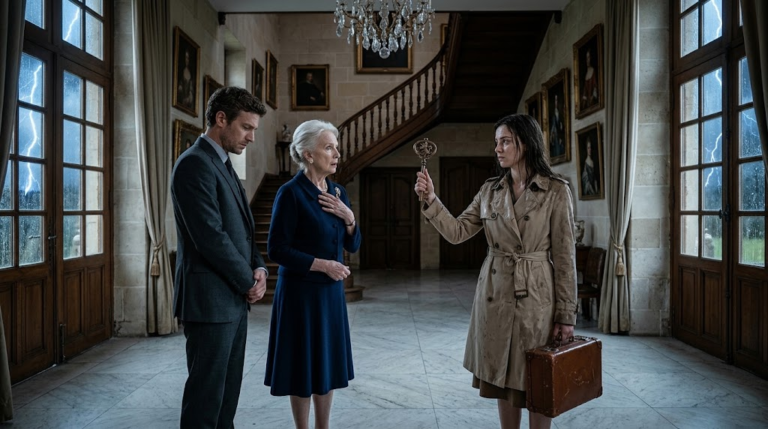
A Family Drama Novel
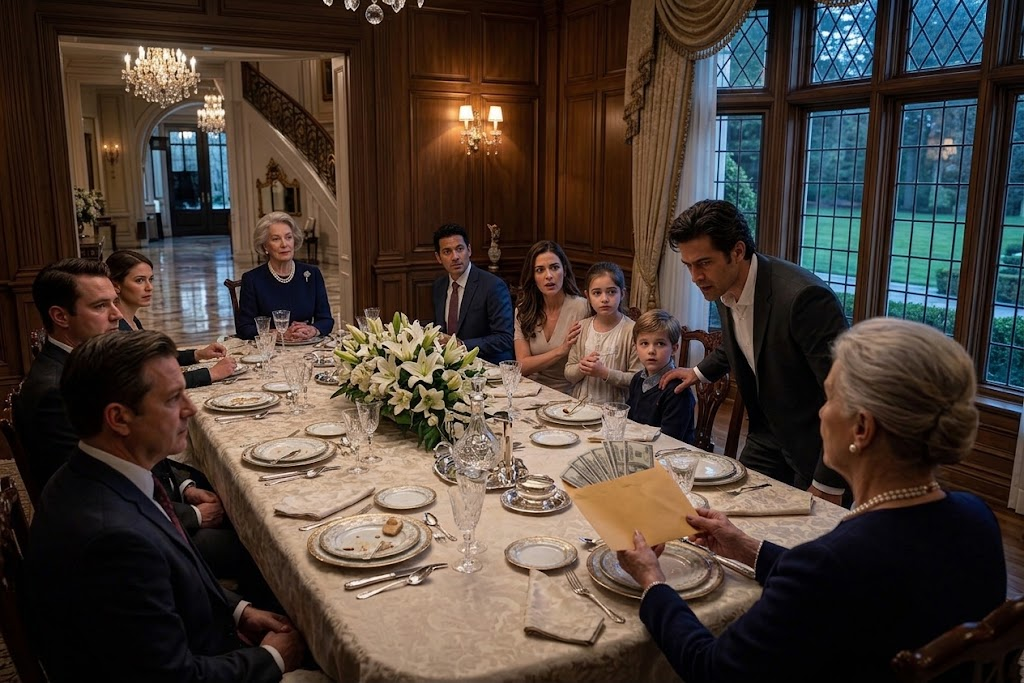
Chap1:
THE EASTER DINNER THAT BROKE OUR FAMILY
PART1/1:
The first time my daughter asked me if she had done something wrong, she was standing in a room full of people who were supposed to love her.
That was the part I could never forget.
Not the money.
Not the argument.
Not even my aunt Margaret’s words.
It was the look on my daughter’s face when she realized something was wrong.
A seven-year-old child should never have to question whether she belongs.
But that afternoon, inside the Harrington family mansion outside Boston, my little girl learned a lesson no child should ever have to learn:
Sometimes the people who share your blood are not the people who protect your heart.
My name is Michael Carter.
I was forty-two years old when everything changed.
Before that Easter Sunday, I believed I understood my family.
I believed family meant history.
Traditions.
Shared memories.
The last name written on old documents.
I believed that because I had grown up as a Harrington.
My mother was a Harrington.
My father was a Harrington.
My grandfather, Thomas Harrington, built the company that carried our name across New England.
For decades, the Harrington name represented success.
Respect.
Legacy.
People in Boston knew that name.
They knew the mansion.
They knew the company.
They knew the family.
But what I learned that Easter was that people can spend generations building a name…
and still forget what that name is supposed to mean.
The Harrington Easter Dinner was not just a meal.
It was an event.
Every year, my aunt Margaret opened the doors of the family estate and invited everyone.
The same traditions.
The same decorations.
The same expensive tableware that had been passed down through generations.
The same stories told over and over again.
People loved saying that the Harrington family valued tradition.
But as I got older, I realized something.
Traditions are only meaningful when they protect people.
When they become more important than people…
they become empty.
The mansion stood on a large piece of land outside Boston.
It was the kind of house people slowed down to look at.
A long stone driveway.
Huge oak trees.
White columns at the entrance.
The original Harrington family crest carved above the front door.
I had spent my childhood running through those halls.
I had celebrated birthdays there.
Christmas mornings.
Graduations.
Family victories.
I once believed that house would always feel like home.
I was wrong.
My wife Emily sat beside me as we drove there that afternoon.
She looked beautiful.
She always did.
Not because she wore expensive clothes.
She never cared about that.
Emily had a kind of beauty that came from the way she treated people.
She noticed when someone was uncomfortable.
She remembered small details.
She helped without being asked.
That was the first thing I loved about her.
She saw people.
Really saw them.
We had been married for twelve years.
Twelve years.
And during those twelve years, Emily had tried harder than anyone to become part of my family.
Maybe too hard.
Looking back, I wonder how many times she smiled through pain just to make things easier for me.
How many times she said:
“It’s okay.”
When it wasn’t.
How many times she forgave people who never apologized.
Emily wasn’t born into wealth.
She didn’t grow up around private schools, country clubs, or family businesses.
Her father owned a small repair shop.
Her mother was a teacher.
They lived simply.
But they taught her something my family had forgotten.
A person’s value was never measured by what they owned.
It was measured by what they gave.
I met Emily at Massachusetts General Hospital.
My mother had undergone surgery, and I was spending most of my days between work and the hospital.
I was exhausted.
Scared.
Trying to pretend I wasn’t.
Emily was the nurse assigned to my mother’s room.
I remember the first conversation we had.
She looked at me and said:
“Your mother is pretending she isn’t afraid.”
I looked confused.
“What?”
Emily smiled gently.
“She keeps telling everyone she’s fine.”
She glanced toward my mother.
“But she keeps holding the blanket.”
I looked over.
She was right.
Nobody else noticed.
But Emily did.
That was Emily.
She noticed what others ignored.
And maybe that’s why my grandfather Thomas Harrington respected her.
Even before I understood it.
When Emily and I got married, my family welcomed her.
At least on the surface.
They smiled.
They congratulated us.
They said the right things.
But over time…
small things started appearing.
Things you notice only when you pay attention.
At family dinners, conversations stopped when Emily approached.
At gatherings, people asked about my career.
My plans.
My future.
But rarely hers.
They accepted her presence.
They didn’t embrace it.
There is a difference.
A big one.
My aunt Margaret was the worst.
She never openly insulted Emily.
That would have been easier.
Instead, she used something more subtle.
Distance.
Politeness without warmth.
Kindness without affection.
She always called her:
“Michael’s wife.”
Never Emily.
Never family.
Never my daughter-in-law.
Just:
Michael’s wife.
For years, I convinced myself it wasn’t important.
I told myself:
“That’s just Margaret.”
“She is difficult with everyone.”
“She will eventually warm up.”
But eventually never came.
Then my mother got sick.
And everything changed.
My mother was diagnosed with Alzheimer’s disease.
At first, everyone promised they would help.
My aunt.
My cousins.
Everyone.
And they did.
For a while.
But life became busy.
People had careers.
Vacations.
Responsibilities.
Slowly, the calls stopped.
The visits became less frequent.
The promises became excuses.
Emily stayed.
She didn’t have to.
But she did.
She learned my mother’s medication schedule.
She cooked meals.
She sat with her during the nights when my mother became confused.
There were moments when my mother forgot my name.
Forgot where she was.
Forgot important memories.
But she always remembered Emily.
Sometimes she would look at Emily and say:
“You remind me of someone.”
Emily would smile.
“Who?”
My mother would answer:
“Someone kind.”
I thought those years would change my family’s opinion of her.
I thought sacrifice created respect.
I thought loyalty created belonging.
But I learned something painful:
Some people only accept you when they need something from you.
That Easter Sunday, I still believed things would be different.
I truly did.
That was my mistake.
When we arrived at the mansion, Sophia immediately grabbed my hand.
“Daddy.”
“What?”
“Do you think Aunt Margaret will like my dress?”
I looked at my daughter.
She was wearing a yellow dress with small white flowers.
Emily had spent an hour choosing it.
Sophia loved it.
She kept spinning around because she said the skirt made her feel like a princess.
I smiled.
“She will love it.”
Sophia smiled.
“Really?”
“Really.”
My son Liam walked beside us.
He was ten.
More observant than most kids his age.
He noticed things.
The way people spoke.
The way people looked at each other.
Sometimes I wondered if he understood more than we realized.
The front door opened before we reached it.
Margaret stood there.
She was sixty-eight years old.
Elegant.
Perfectly dressed.
Every detail controlled.
Her silver hair.
Her jewelry.
Her expression.
Margaret never looked unprepared.
“Michael.”
She kissed my cheek.
“Glad you came.”
Then her eyes moved behind me.
Emily.
Liam.
Sophia.
Her smile changed.
Only slightly.
But I noticed.
“Everyone made it.”
Not:
“I’m happy you’re here.”
Just:
“You arrived.”
Emily smiled politely.
“Happy Easter, Margaret.”
Margaret nodded.
“Emily.”
That was all.
No hug.
No warmth.
No welcome.
Just a name.
I looked at Emily.
She smiled.
But I knew her.
And I knew that smile.
It was the smile she used when she didn’t want me to worry.
Inside, the house was full.
Thirty family members.
Children running through the halls.
Adults laughing.
The smell of roasted lamb and fresh bread filled the room.
Everything looked perfect.
Almost too perfect.
Sophia looked around excitedly.
“Wow.”
She whispered.
I smiled.
“Remember to say thank you.”
“I will.”
She held her little Easter basket tightly.
Inside was a card she made for Margaret.
I didn’t know then…
that card would never be given.
Dinner started at six.
Everyone sat around the long dining table.
The same table where generations of Harringtons had celebrated together.
The same table where my grandfather once sat at the head.
Now Margaret sat there.
And everyone adjusted around her.
Conversation flowed.
Business.
Travel.
Family updates.
The usual.
But I noticed something.
Emily was quieter than usual.
I touched her hand under the table.
“You okay?”
She smiled.
“I’m fine.”
Those words.
Again.
“I’m fine.”
The words she always used.
Even when she wasn’t.
After dinner, Margaret stood.
Immediately, everyone became quiet.
The children knew.
The Easter envelopes.
A tradition that had existed for years.
Every child received one.
A small gift from the family.
Five hundred dollars.
Not because anyone needed it.
Because it represented something.
At least…
I thought it did.
Margaret walked to a small velvet purse.
The children became excited.
Sophia sat straighter.
She looked at me.
“Daddy.”
“Yes?”
“I think it’s my turn.”
I smiled.
“I think so too.”
I was wrong.
END OF CHAPTER 1 — PART 1
Part 2/2
I still remember the sound of that room after Margaret closed the velvet purse.
Silence.
Not ordinary silence.
Not the comfortable silence after a good conversation.
This was the kind of silence that happens when everyone knows something wrong has just happened…
but nobody wants to be the first person to admit it.
Sophia was still standing there.
Her little hand was still slightly raised.
Waiting.
She didn’t understand why nobody was talking.
Children don’t think like adults.
They don’t immediately assume someone is being cruel.
They look for another explanation.
Maybe someone forgot.
Maybe there was a mistake.
Maybe they misunderstood.
That was what my daughter was doing.
She was trying to find a reason that didn’t hurt.
“Aunt Margaret?”
Her voice was soft.
“Did you forget mine?”
I felt something break inside me.
Because she wasn’t demanding anything.
She wasn’t angry.
She wasn’t asking for money.
She was giving Margaret a chance to fix it.
A chance to say:
“Oh sweetheart, I’m sorry. Here you go.”
A chance to be kind.
But Margaret didn’t take it.
Instead, she looked at my daughter with a calm expression.
Too calm.
“No, Sophia.”
A pause.
“I didn’t forget.”
My daughter’s smile slowly disappeared.
“Then…”
She looked at the other children.
“Why didn’t I get one?”
Nobody moved.
Nobody breathed.
At least that’s how it felt.
My aunt placed the purse on the table.
“The envelopes are for family.”
I stared at her.
“Sophia is family.”
Margaret looked at me.
“You know what I mean.”
“No.”
My voice became colder.
“I don’t.”
She sighed.
Like I was the one making things complicated.
“Michael, the Harrington Easter tradition is for Harrington children.”
I looked at Liam.
Then Sophia.
Then back at her.
“They are my children.”
“Yes.”
She nodded.
“But they don’t share our blood.”
There it was.
The sentence.
The one I would never forget.
Not because it was loud.
Not because it was cruel in the way people usually imagine cruelty.
It was worse.
It was calm.
Delivered like a fact.
Like she was simply explaining something obvious.
Sophia looked confused.
She looked at me.
Then at Emily.
Then back at Margaret.
“What does that mean?”
Nobody answered.
So she asked again.
“What does blood mean?”
That question destroyed me.
Because my daughter was asking adults to explain why they had decided she wasn’t enough.
And every adult in the room was suddenly silent.
Emily moved closer to her.
She gently placed a hand on Sophia’s shoulder.
“Sweetheart, come here.”
Sophia walked back to her mother.
But she kept looking at Margaret.
Trying to understand.
I looked around the table.
My cousins.
My parents.
The entire Harrington family.
And what hurt most wasn’t Margaret’s words.
It was everyone else’s silence.
Because Margaret was one person.
One person could be wrong.
One person could be cruel.
But thirty people staying quiet?
That was a choice.
My eyes stopped at my father.
“Dad.”
He looked up.
I waited.
I don’t even know what I wanted him to say.
Maybe:
“Margaret, that’s enough.”
Maybe:
“Those are your grandchildren.”
Maybe:
“Michael, I’m sorry.”
Anything.
But my father looked down.
And that moment changed something between us.
Because I realized he wasn’t unable to speak.
He was choosing not to.
My mother looked like she wanted to say something.
Her lips moved.
But no words came.
And somehow…
that hurt almost as much.
Emily had spent twelve years trying to be accepted by these people.
Twelve years.
She helped my mother.
She helped my grandmother.
She attended every gathering.
She remembered every birthday.
She showed up when people needed her.
And in return?
They couldn’t even defend her daughter.
I walked toward Sophia.
I knelt down.
“Hey.”
She looked at me.
Her eyes were starting to fill with tears.
“Did I do something wrong?”
There are moments in life when you wish you could take away someone’s pain.
Not fix it.
Not explain it.
Just remove it.
That was one of those moments.
“No.”
I touched her cheek.
“No, sweetheart.”
“But she said…”
“I know what she said.”
I looked at Margaret.
Then back at my daughter.
“But she was wrong.”
Sophia whispered:
“Why doesn’t she like me?”
That question hurt more than anything.
Because children always assume rejection is their fault.
They don’t understand that sometimes adults carry their own brokenness.
And they throw it onto innocent people.
Before I could answer, Margaret spoke again.
“Michael, you’re making this emotional.”
I slowly stood.
“Emotional?”
She nodded.
“Yes.”
She looked around.
“This is becoming unnecessary.”
I couldn’t believe what I was hearing.
“My daughter is standing here wondering if she did something wrong.”
“She will get over it.”
The room became colder.
Even Margaret realized she had said too much.
But she didn’t apologize.
I looked at her.
“You really believe this is about money?”
She didn’t answer.
“It was never about the money.”
I pointed toward Sophia.
“It’s about what you just taught her.”
Margaret crossed her arms.
“And what did I teach her?”
I looked directly at her.
“That some people have to prove they belong.”
For a moment…
nobody spoke.
Because everyone knew.
That was exactly what happened.
Then Emily finally spoke.
Her voice was quiet.
But everyone heard it.
“You should have told me years ago.”
Margaret looked at her.
“Told you what?”
Emily smiled sadly.
“That no matter how much I did…”
A pause.
“…you would never see me as one of you.”
The room changed.
Because for the first time, Emily wasn’t trying to be accepted.
She wasn’t asking.
She wasn’t explaining.
She was simply stating the truth.
Margaret looked offended.
“Emily, don’t exaggerate.”
Emily shook her head.
“No.”
She looked around the table.
“I’m not.”
She looked at my parents.
“How many years have I been here?”
Nobody answered.
“How many times have I helped this family?”
Silence.
“How many times did I show up when everyone else was too busy?”
My mother’s eyes filled with tears.
Because she knew.
Everyone knew.
Emily looked at Margaret.
“I never needed your money.”
A pause.
“I never needed your name.”
Another pause.
“I only wanted my children to feel loved by the people who claimed to love us.”
That sentence destroyed the room.
Because it exposed the truth.
This was never about an envelope.
It was about belonging.
I reached for Emily’s hand.
Then Liam’s.
Then Sophia’s.
“We’re leaving.”
My father looked up.
“Michael…”
I stopped.
I turned around.
Again, I waited.
Again, I hoped.
But he said nothing.
Margaret shook her head.
“You are walking away over this?”
I looked at her.
“No.”
A pause.
“I’m walking away because of what this showed me.”
I looked around the room.
“Family isn’t the people who share your blood.”
Nobody moved.
“Family is the people who protect you when you’re standing right in front of them.”
I took Sophia’s hand.
She held it tightly.
I took Liam’s.
Then Emily’s.
And we walked out.
Nobody followed.
Nobody apologized.
Nobody stopped us.
The front door closed behind us.
And the sound echoed through the mansion.
The rain had started.
Small drops falling against the driveway.
Sophia looked back at the house.
The place she had entered smiling.
Now she looked uncertain.
“Daddy?”
I looked down.
“Yes?”
“Are we still family?”
That question nearly broke me.
Because my daughter wasn’t asking about Margaret anymore.
She was asking about all of them.
About everyone inside that house.
I knelt beside her.
“Listen to me.”
She looked at me.
“You, Liam, and your mother…”
I looked at Emily.
“…you are my family.”
A pause.
“The most important family I have.”
We drove home in silence.
Usually, Sophia talked nonstop.
She told stories.
Asked questions.
Sang songs.
That night, she stared out the window.
Holding the Easter basket on her lap.
When we arrived home, the children went upstairs.
Emily helped them change.
I stood in the kitchen alone.
Looking at my phone.
Six missed calls.
Margaret.
Three.
My mother.
Two.
My father.
One.
I ignored them.
Not because I didn’t care.
Because for the first time in my life…
I didn’t care about keeping everyone else comfortable.
Later that night, Emily sat across from me.
The house was quiet.
The children were asleep.
But neither of us felt peaceful.
“I’m sorry.”
I said it quietly.
Emily looked up.
“For what?”
“For bringing you into a family that never truly accepted you.”
She looked at me for a long moment.
Then she smiled.
A sad smile.
“Michael.”
“What?”
“I never married your family.”
She reached across the table.
“I married you.”
Those words stayed with me.
Because Emily understood something I didn’t.
She had never needed the Harrington name.
She had never needed their approval.
She only wanted love.
At 12:17 a.m., my phone rang again.
I looked at the screen.
Dad.
I almost ignored it.
But something made me answer.
“Hello?”
Silence.
Then:
“Michael.”
My father’s voice sounded different.
Not angry.
Not disappointed.
Afraid.
“What happened?”
He took a deep breath.
“You need to listen to me.”
I sat up.
“Why?”
Another pause.
Then he said:
“Because everything you believe about this family…”
My heart started beating faster.
“…is wrong.”
I didn’t speak.
Then my father whispered:
“Your aunt didn’t exclude your children because they weren’t family.”
A pause.
“She did it because she was afraid.”
“Afraid of what?”
His answer changed everything.
“Your wife.”
I looked toward the stairs.
Toward Emily.
Toward the woman who had just been called an outsider.
My father continued:
“Michael…”
“Your wife is the reason Harrington Industries survived.”
The call ended.
And for the first time that night…
I wondered if walking away from my family…
was actually the moment I finally discovered the truth about them.
END OF CHAPTER 1
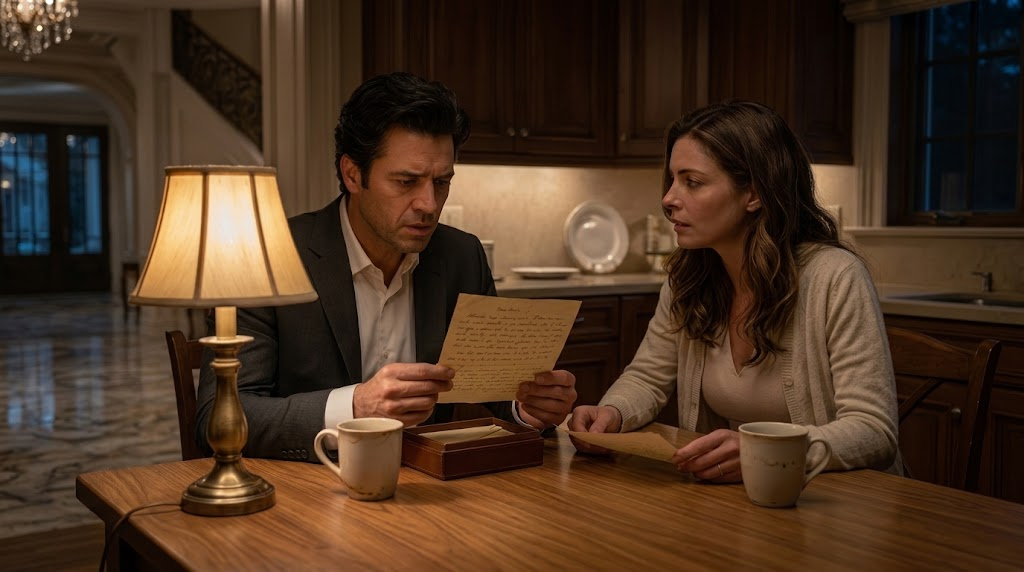
CHAPTER 2
THE SECRET MY WIFE CARRIED FOR EIGHT YEARS
Part 1/2
Secrets have a strange way of changing the meaning of the past.
Before that night, I remembered my family differently.
I remembered Easter dinners.
Birthday celebrations.
Holiday gatherings.
My grandfather’s office.
The Harrington name.
But after my father’s phone call…
every memory became a question.
How long had they known?
What else had been hidden?
And the biggest question of all:
What had my wife been carrying alone?
I didn’t sleep.
Not even for a few minutes.
I sat in the dark living room long after Emily went upstairs.
The house was completely quiet.
The kind of quiet that normally feels peaceful.
But that night, it felt heavy.
Every few minutes, I looked toward the staircase.
Emily was upstairs.
The same woman I had loved for twelve years.
The same woman who had stood beside me through everything.
But suddenly…
I realized there was an entire part of her life I didn’t know.
At 5:30 in the morning, I finally heard footsteps.
Emily walked into the kitchen.
She looked tired.
Not because she hadn’t slept.
Because she knew.
She knew my father had told me something.
“You know.”
It wasn’t a question.
I looked at her.
“How long?”
She stopped.
“Michael…”
“How long have you known?”
A long silence followed.
Then she quietly answered:
“Eight years.”
Eight years.
The number felt impossible.
“You knew for eight years that something was happening with my family?”
Emily sat down.
“I knew something was wrong.”
“That’s not the same thing.”
“No.”
She looked at me.
“But it was close.”
I wasn’t angry at her.
That was the strange part.
I was hurt.
There is a difference.
Anger wants someone to blame.
Hurt wants to understand.
And I wanted to understand.
“Why didn’t you tell me?”
Emily looked down.
“I wanted to.”
“But?”
She took a breath.
“But your grandfather asked me not to.”
I stared at her.
“My grandfather?”
She nodded.
“Thomas.”
I almost laughed.
Not because it was funny.
Because it sounded impossible.
“My grandfather trusted you with a secret?”
Emily looked at me.
“Yes.”
The more she explained…
the more I realized how much I had missed.
Small moments.
Small signs.
Things I ignored because I thought they meant nothing.
My grandfather Thomas Harrington had always been different from the rest of the family.
Everyone saw him as a businessman.
A billionaire.
A man who built an empire.
But I remembered another side.
The side nobody talked about.
The grandfather who sat with me when I was young.
The grandfather who taught me how to fix things with my hands.
The grandfather who always said:
“A person’s character is revealed when nobody is watching.”
I remembered something from years earlier.
A family dinner.
Emily had been married into the family for only a few months.
Everyone was talking about business.
Stocks.
Investments.
The future of Harrington Industries.
Emily was quiet.
Not because she didn’t understand.
Because she didn’t want to interrupt.
Then my grandfather suddenly asked:
“Emily, what do you think?”
Everyone looked surprised.
Including her.
“About what?”
“The company.”
She smiled nervously.
“I don’t know enough to have an opinion.”
My grandfather shook his head.
“That’s not true.”
He looked around the table.
“Most people who speak the loudest know the least.”
At the time, I thought it was just a kind comment.
Now…
I wondered if he had already seen something everyone else missed.
“Tell me everything.”
I said.
Emily looked at me.
“Are you sure?”
“Yes.”
A pause.
“Because once I know, I can’t pretend anymore.”
She nodded.
“I know.”
She began with my grandmother.
When my grandmother became sick, Emily spent more time at the Harrington estate than anyone else.
She helped organize medical paperwork.
Appointments.
Insurance documents.
Everything.
That was how she first noticed something strange.
“Strange how?”
Emily hesitated.
“Financial records.”
I frowned.
“Financial records?”
She nodded.
“Your grandmother had several documents related to family assets and medical expenses.”
“And?”
“Some numbers didn’t match.”
At first, Emily assumed it was an accounting error.
Nothing more.
But then she noticed something else.
Money was moving.
Large amounts.
Repeatedly.
Through accounts connected to Harrington Industries.
“Why did you look into it?”
I asked.
“I wasn’t trying to investigate.”
She looked down.
“I was just trying to understand.”
That was Emily.
She never searched for problems.
Problems found her.
She started quietly checking information.
Not because she wanted to expose anyone.
Because something felt wrong.
And eventually…
she discovered the truth.
“Harrington Industries was losing money.”
I frowned.
“That doesn’t make sense.”
Everyone knew the company was successful.
That was the story.
The public story.
But behind closed doors…
things were different.
“The company was close to collapse.”
I stared at her.
“How close?”
“Very close.”
“Why didn’t anyone know?”
“Because people were hiding it.”
My stomach tightened.
“Who?”
Emily looked at me.
“Margaret.”
The name felt heavier this time.
Because now I understood.
My aunt wasn’t just cruel.
She wasn’t just arrogant.
She was protecting something.
“What did she do?”
Emily looked away.
“She made decisions that benefited herself.”
“Illegal?”
A pause.
“Yes.”
I stood and walked toward the window.
The same family.
The same people.
But everything was changing.
“Why didn’t Grandpa expose her?”
Emily’s face became sad.
“Because she was his daughter.”
That answer hurt.
Because it showed something important.
Thomas Harrington wasn’t a man who didn’t know what was happening.
He knew.
He simply couldn’t destroy his own child.
“So what did he do?”
Emily looked at me.
“He asked me for help.”
I turned around.
“You?”
She nodded.
“Why you?”
She smiled slightly.
“Because nobody thought I mattered.”
That sentence stayed with me.
Because it was true.
Margaret ignored Emily.
The family underestimated Emily.
They saw her as a nurse.
A wife.
An outsider.
Exactly because of that…
she was invisible.
“Your grandfather knew Margaret watched everyone close to her.”
Emily continued.
“He knew she would suspect anyone inside the family.”
“But not you.”
“No.”
She shook her head.
“Because I wasn’t a threat.”
The irony was painful.
The woman they treated like she didn’t belong…
was the only person they trusted to protect them.
“What did Grandpa ask you to do?”
Emily took a deep breath.
“Find out what was really happening.”
For months, Emily worked quietly.
She reviewed records.
Talked to financial experts.
Found connections.
She discovered hidden transactions.
Money transfers.
Private accounts.
Evidence.
“Did Margaret know?”
“Eventually.”
“When?”
“When your grandfather became sick.”
I looked at her.
“What happened?”
Emily’s eyes changed.
For the first time…
I saw anger.
Real anger.
“She confronted me.”
The room became silent.
“What did she say?”
Emily looked at the table.
“She told me I needed to remember my place.”
My hands tightened.
“Your place?”
She nodded.
“She said I was only there because I married you.”
I closed my eyes.
Because that sounded exactly like Margaret.
“What did you say?”
Emily smiled sadly.
“I said nothing.”
I looked surprised.
“Nothing?”
“No.”
“Why?”
She looked at me.
“Because your grandfather told me something.”
“What?”
“He said…”
She paused.
“Don’t fight people who are trying to prove you don’t belong. Let your actions answer for you.”
That was my grandfather.
That was the man I remembered.
Not perfect.
But wise.
Then Emily said something I never expected.
“Michael.”
“Yes?”
“There’s something else.”
My heart sank.
“What?”
She looked toward the hallway.
“The reason Margaret hates me…”
A pause.
“…isn’t because I discovered what she did.”
I waited.
“Then why?”
Emily whispered:
“Because I had the chance to take everything she wanted.”
I frowned.
“What does that mean?”
She didn’t answer.
Instead, she walked to the cabinet.
Opened a drawer.
And pulled out an old envelope.
The handwriting on it made me freeze.
Thomas Harrington.
My grandfather.
Emily placed it on the table.
“He left this for you.”
I stared at it.
“For me?”
She nodded.
“But I wasn’t allowed to give it to you until your family showed who they really were.”
I touched the envelope.
And suddenly…
the Easter dinner made sense.
Margaret hadn’t just insulted my children.
She had revealed herself.
I looked at Emily.
“What did he write?”
She whispered:
“The truth.”
I opened the envelope.
The first sentence immediately changed everything.
Michael,
If you are reading this, then the family has failed the test.
I stopped breathing.
Because I knew immediately…
whatever came next would change everything I thought I knew about the Harrington family.
END OF CHAPTER 2 — PART 1
Part 2/2
I stared at the first sentence of my grandfather’s letter for what felt like an eternity.
If you are reading this, then the family has failed the test.
Those words were not what I expected.
I expected explanations.
Numbers.
Evidence.
Something connected to the company.
But not that.
A test.
Because suddenly I understood something.
My grandfather had not simply been preparing for a business problem.
He had been preparing for a family problem.
I looked at Emily.
“Did you know what this said?”
She shook her head.
“No.”
“You never read it?”
“No.”
“Why?”
She touched the envelope gently.
“Because it was meant for you.”
I opened the letter completely.
The paper was old.
The ink had faded slightly.
But my grandfather’s handwriting was still unmistakable.
Strong.
Precise.
The handwriting of a man who believed every word mattered.
I began reading.
Michael,
If you are holding this letter, then something has happened that forced the truth into the open.
I hoped this day would never come.
But I also knew hope alone was not enough.
I swallowed.
Because that sounded like him.
My grandfather always believed preparation was a form of love.
He didn’t prepare because he expected disaster.
He prepared because he wanted to protect people from it.
I continued.
For many years, I believed my greatest achievement was building Harrington Industries.
I was wrong.
A company can be rebuilt.
Money can be replaced.
A reputation can be repaired.
But trust…
Once destroyed, trust is the hardest thing to recover.
I stopped reading.
Because those words felt like they were written for me.
Not just about business.
About family.
Emily sat silently across from me.
She wasn’t trying to influence my reaction.
She wasn’t trying to defend herself.
She was simply letting me discover the truth.
That was another thing about Emily.
She never forced people to see her.
She waited until they were ready.
I continued.
Michael, you have always believed the best in people.
That is one of your greatest strengths.
It is also your greatest weakness.
I looked down.
Because my grandfather knew me too well.
I always gave people another chance.
Sometimes too many.
You will want to believe that the people closest to you would never betray you.
But remember this:
Family does not remove the responsibility to choose what is right.
The words became heavier.
Because I knew where this was going.
Eight years ago, I discovered something that broke my heart.
Not because of the money.
Not because of the company.
But because the person who endangered everything was someone I loved.
I looked at Emily.
She looked down.
Even after everything…
she still felt sympathy.
That was the difference between her and Margaret.
Margaret has always been intelligent.
She has always been ambitious.
But somewhere along the way, she confused protecting the family name with protecting herself.
I closed my eyes.
There it was.
The truth.
The reason behind everything.
Margaret wasn’t protecting tradition.
She was protecting control.
The letter continued.
I confronted Margaret.
I gave her a choice.
Tell the truth and repair the damage.
Or continue hiding until the truth destroys everything.
I looked at Emily.
“What happened?”
She answered quietly.
“She chose to hide.”
My hands tightened around the letter.
That was when I realized something painful.
The greatest danger to a family is not always the person who causes harm.
Sometimes it is the person who sees the harm and chooses silence.
I immediately thought of my father.
And the way he looked away at Easter.
The next paragraph was about Emily.
And that was the part I was not prepared for.
Emily Carter was never supposed to be part of this story.
She was not born a Harrington.
She did not inherit our wealth.
She did not carry our name.
I looked at Emily.
She stared at the floor.
And yet, she was the only person who protected everything this family built.
My throat tightened.
Because those words came from the man whose opinion everyone respected most.
I watched Emily for months.
I watched how she treated your grandmother.
I watched how she treated employees.
I watched how she treated people who could offer her nothing.
A pause.
That is when I understood something:
Character is revealed when there is nothing to gain.
I stopped reading.
Because that sentence explained my grandfather.
And it explained Emily.
“Michael…”
Emily whispered.
I looked up.
She looked emotional.
“I didn’t want you to find out like this.”
I frowned.
“Why?”
She looked at me.
“Because I never wanted you to feel like you owed me.”
That sentence hit me harder than anything else.
Because Emily wasn’t afraid I would be angry.
She was afraid I would feel guilty.
I continued reading.
Emily saved Harrington Industries during its darkest moment.
But she refused recognition.
She refused ownership.
She refused anything that would make people believe she helped us for personal gain.
I looked at Emily.
“Is that true?”
She nodded.
“Why?”
She smiled sadly.
“Because your grandfather didn’t need another person fighting for control.”
A pause.
“He needed someone protecting what mattered.”
The letter continued.
I offered Emily a position within Harrington Industries.
I offered her ownership.
I offered her the recognition she deserved.
My eyes widened.
I already knew where this was going.
She refused.
I looked at Emily.
“You turned it down?”
She nodded.
“Yes.”
“Why?”
Her answer was simple.
“Because I didn’t want to own your family’s company.”
A pause.
“I wanted to build a life with you.”
For a moment…
I couldn’t speak.
Because all those years, I thought Emily was trying to enter my family.
But she wasn’t.
She was trying to love me.
The letter continued.
Michael,
If you ever find yourself choosing between someone who shares your blood and someone who shares your values…
Choose carefully.
I felt tears forming.
Because I knew exactly what my grandfather was saying.
Then came the final paragraph.
The one that changed everything.
The future of Harrington Industries should never belong to the person who demands it.
It should belong to the person willing to sacrifice for it.
Below that was one final sentence.
If Margaret ever threatens this family again, the person with the authority to protect Harrington Industries is Emily Carter.
I stopped reading.
My entire body went still.
“What?”
Emily looked at me.
“I didn’t know.”
I looked at the letter.
Then at her.
“You’re saying my grandfather gave you control?”
“Not control.”
She shook her head.
“Protection.”
I leaned back.
The woman my aunt called an outsider…
had been trusted more than anyone in the family.
Suddenly, Easter dinner looked different.
The envelope.
The insult.
The humiliation.
It wasn’t about money.
Margaret had spent years trying to prove Emily didn’t belong.
Because she was terrified of one thing.
The person she rejected…
was the person who could expose her.
But there was still one thing I didn’t understand.
“Why now?”
Emily looked at me.
“What?”
“Why did Grandpa wait?”
She was quiet.
Then she answered:
“Because he believed people reveal themselves when they think they have power.”
I thought about Margaret.
Standing there.
Closing the purse.
Looking at Sophia.
Thinking she controlled the room.
Emily continued.
“He knew one day Margaret would make a choice.”
“What choice?”
Emily looked at me.
“The choice between protecting the family…”
A pause.
“…or protecting herself.”
The next morning, my father arrived at our house.
He looked exhausted.
Before he even spoke, I knew.
Something had happened.
“Michael.”
I opened the door.
“Dad.”
He looked past me.
At Emily.
Then back at me.
“I owe both of you the truth.”
Emily stepped forward.
“Come inside.”
We sat at the kitchen table.
The same table where Emily had told me her secret.
My father placed a folder down.
“I should have done this years ago.”
I looked at the folder.
“What is it?”
He took a breath.
“Evidence.”
My heart sank.
“Of what?”
He looked at Emily.
“Everything.”
Inside the folder were financial records.
Company documents.
Emails.
Transactions.
Names.
Dates.
My father whispered:
“Your aunt didn’t just make bad decisions.”
A pause.
“She planned everything.”
I looked at Emily.
And for the first time…
I realized something.
The Easter dinner wasn’t the beginning of the problem.
It was the moment the problem finally became impossible to hide.
My father looked at me.
“Michael.”
“Yes?”
“Your aunt is going to fight back.”
I closed the folder.
“Let her.”
Because for the first time in my life…
I wasn’t protecting the Harrington name.
I was protecting my family.
END OF CHAPTER 2
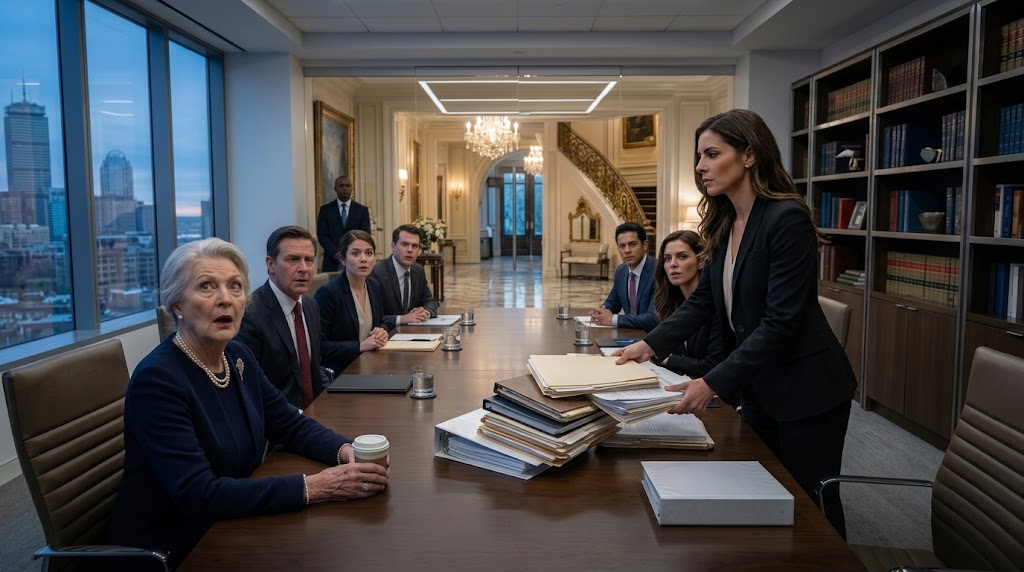
CHAPTER 3
THE WOMAN WHO SAVED THE HARRINGTON NAME
Part 1/2
There is a difference between knowing someone’s story…
and understanding what they sacrificed.
For twelve years, I had loved Emily.
I knew her habits.
Her dreams.
Her fears.
I knew how she took her coffee.
I knew she always checked that the doors were locked before going to bed.
I knew she cried when she saw old people eating alone at restaurants.
I knew she kept every handwritten card our children ever made her.
I thought I knew my wife.
But I didn’t know the most important thing about her.
I didn’t know how much she had given away…
without ever asking anyone to notice.
After my father left that morning, I sat at the kitchen table staring at the documents.
Numbers.
Accounts.
Contracts.
Evidence.
A world I had never seen.
The world behind the Harrington name.
The world my family had spent years hiding.
Emily stood by the counter making tea.
I watched her.
And something bothered me.
Not because I doubted her.
Because I finally understood how alone she must have felt.
Eight years.
Eight years carrying a secret.
Eight years knowing my family was in danger.
Eight years watching people treat her like an outsider while she protected them.
“Emily.”
She turned.
“Yes?”
“Why didn’t you tell me after Grandpa died?”
She became quiet.
“I wanted to.”
“But?”
She looked down.
“Your grandfather asked me not to reveal everything immediately.”
“Why?”
She sighed.
“Because he wanted Margaret to have a chance.”
I couldn’t understand.
“A chance?”
Emily nodded.
“He believed people could choose to do the right thing.”
“And she didn’t.”
“No.”
Her voice was soft.
“She didn’t.”
That was the thing about my grandfather.
He always believed people could become better.
Maybe that was his greatest strength.
Maybe it was also his greatest weakness.
Because some people don’t change when given kindness.
Some people mistake kindness for weakness.
“Tell me about the company.”
Emily sat across from me.
“All of it.”
She looked at the papers.
“Are you sure?”
I nodded.
“This is my family.”
A pause.
“And you are my wife.”
She took a deep breath.
Then she began.
Eight years earlier, Harrington Industries looked successful from the outside.
The company was expanding.
Projects were everywhere.
The newspapers praised my grandfather’s legacy.
Investors believed the company was stronger than ever.
But inside…
everything was falling apart.
“Your grandfather knew something was wrong.”
Emily explained.
“He noticed the numbers didn’t match.”
“What numbers?”
“Revenue reports. Expenses. Investment records.”
“And Margaret?”
“She was controlling financial decisions.”
I leaned forward.
“So she was stealing?”
Emily paused.
“Not exactly at first.”
“What does that mean?”
“She wasn’t taking money directly.”
She looked at me.
“She was manipulating the company.”
Margaret had been making risky decisions.
Moving money.
Creating unnecessary expenses.
Approving investments that benefited certain people connected to her.
At first, it looked like poor judgment.
Then it became a pattern.
“Why would she do that?”
Emily looked at me.
“Power.”
That answer was simple.
But it explained everything.
Margaret didn’t just want money.
She wanted control.
She wanted to be the person everyone depended on.
The person who could say:
“Without me, this family fails.”
My grandfather saw it.
And he was terrified.
Not because the company might collapse.
Because his family might destroy itself trying to control it.
“What did he ask you to do?”
Emily looked at me.
“He asked me to find the truth.”
She explained how it started.
Small things.
Reviewing documents.
Checking records.
Asking questions.
She wasn’t a financial expert.
She wasn’t a corporate executive.
She was simply someone who paid attention.
“Your grandfather told me something.”
“What?”
“He said, ‘The people closest to the problem are often the last ones willing to see it.'”
I smiled sadly.
“That sounds like him.”
Emily nodded.
“He knew his children.”
The investigation took months.
Emily worked quietly.
During the day, she helped my grandmother.
At night, she reviewed documents.
She contacted experts.
She followed financial trails.
She collected evidence.
“How did you handle everything?”
I asked.
She smiled slightly.
“I didn’t.”
“What?”
“I struggled.”
That answer surprised me.
Because Emily always looked strong.
But strength doesn’t mean something is easy.
“There were nights I cried.”
She admitted.
“There were nights I wanted to stop.”
“Why didn’t you?”
She looked at me.
“Because your grandfather trusted me.”
That was Emily.
She wasn’t motivated by money.
She wasn’t motivated by recognition.
She was motivated by responsibility.
Then she told me the part I never expected.
The part that changed how I saw everything.
“The company needed money.”
I frowned.
“How much?”
She hesitated.
“Three million dollars.”
I froze.
“Emily.”
She looked away.
“I had an inheritance.”
I stared at her.
“From your father?”
She nodded.
“My father left it to me.”
I knew Emily had inherited money.
But I never knew how much.
I never asked.
Because she never talked about it.
She never used it.
She never acted like someone wealthy.
“You gave three million dollars…”
My voice stopped.
She nodded.
“To save Harrington Industries?”
“Yes.”
I stood up.
I couldn’t sit anymore.
Because suddenly every family dinner felt different.
Every time someone ignored Emily.
Every time Margaret treated her like she didn’t belong.
I thought about what they didn’t know.
She had saved them.
And they had spent years making her feel like she wasn’t one of them.
“Why?”
The word came out quietly.
Emily looked confused.
“Why what?”
“Why would you do that?”
She looked at me.
And her answer was exactly what I expected.
Because it was Emily.
“Because your grandfather needed help.”
A pause.
“Because your family needed help.”
Another pause.
“Because they were your family.”
I looked away.
Because I didn’t know how to respond.
“You could have lost everything.”
She smiled.
“I know.”
“You could have invested that money.”
“I know.”
“You could have changed your own life.”
She nodded.
“I know.”
“Then why?”
Emily reached across the table.
She held my hand.
“Because love isn’t measured by what you keep.”
A pause.
“It’s measured by what you’re willing to give.”
That sentence stayed with me.
Because it explained everything about her.
But then I remembered something.
“The ownership.”
Emily became quiet.
I knew immediately.
This was the part she didn’t want to talk about.
“My grandfather offered you shares.”
She nodded.
“Yes.”
“How much?”
“Twenty percent.”
I couldn’t believe it.
Twenty percent of Harrington Industries.
That wasn’t a gift.
That was power.
That was influence.
That was a fortune.
“And you refused?”
She nodded.
“Why?”
She looked at me.
“Because I didn’t want your family to accept me because I saved them.”
A pause.
“I wanted them to accept me because I was me.”
I felt my chest tighten.
Because that was the truth.
Emily never wanted a place because she earned it.
She wanted a place because she belonged.
Before I could answer, my phone rang.
My father.
I picked up.
“Hello?”
His voice was tense.
“Michael.”
“What happened?”
“Margaret called a family meeting.”
I frowned.
“Why?”
A long pause.
“Because she knows.”
My stomach tightened.
“Knows what?”
“She knows Emily has the documents.”
I looked at my wife.
She already understood.
The war had started.
“Where?”
My father answered.
“The Harrington conference room.”
“When?”
“Tomorrow.”
I hung up.
Emily looked at me.
“She’s going to attack.”
I nodded.
“Yes.”
She looked calm.
Too calm.
“Are you afraid?”
I asked.
She thought for a moment.
“No.”
“Why?”
She looked toward the hallway.
Toward our children.
“Because this time…”
A pause.
“I won’t be standing alone.”
The next day, we entered the Harrington conference room.
The same room where generations of decisions had been made.
The same room where powerful people decided the future.
But this time…
the future was about to change.
Margaret sat at the head of the table.
Of course she did.
She looked confident.
Almost relaxed.
Like she already knew how the story would end.
Everyone was there.
My parents.
My cousins.
The board members.
The family.
Margaret stood.
“Thank you all for coming.”
Her eyes moved toward Emily.
“Today, we need to discuss something important.”
Emily remained silent.
Margaret continued.
“Some accusations have been made against me.”
A pause.
“By someone who was never truly part of this family.”
The room became uncomfortable.
Because everyone knew who she meant.
Margaret looked directly at Emily.
“You have manipulated this family for years.”
I felt anger rising.
But Emily touched my hand.
Not yet.
Margaret continued.
“You hid information.”
“You interfered in company decisions.”
“You placed yourself in a position you had no right to hold.”
Then she said the words she thought would destroy Emily.
“You are not a Harrington.”
The room went silent.
But this time…
something was different.
Because Emily didn’t look hurt.
She looked ready.
She opened her folder.
Placed the first document on the table.
Then looked at Margaret.
And said:
“You’re right about one thing.”
Everyone waited.
Emily continued:
“I was never a Harrington by blood.”
A pause.
Then:
“But I protected this family more than the people who were born into it.”
Nobody moved.
Emily opened the next document.
And Margaret’s expression changed.
Because she realized something.
Emily wasn’t defending herself.
She was ending the lie.
END OF CHAPTER 3 — PART 1
Part 2/2
The room was silent.
Not the uncomfortable silence from Easter dinner.
Not the silence of people refusing to speak.
This was different.
This was the silence of people realizing the truth was finally standing in front of them.
Margaret remained standing.
For the first time in my life, I saw uncertainty on her face.
Not fear.
Not yet.
But uncertainty.
Because Margaret Harrington had spent years controlling every conversation.
She knew how to redirect blame.
She knew how to make people question themselves.
She knew how to turn problems into distractions.
But she had never faced someone like Emily.
Someone who wasn’t fighting for power.
Someone who wasn’t fighting for revenge.
Someone who was simply telling the truth.
Emily placed the first document on the table.
“This is the financial report from eight years ago.”
Nobody moved.
“The report that was never shown to the family.”
She placed another paper beside it.
“This is the original version.”
Then another.
“And this is the version that was submitted to the board.”
My cousin Daniel leaned forward.
“The numbers are different.”
Emily nodded.
“Yes.”
The room changed.
Because numbers don’t have emotions.
They don’t have opinions.
They don’t care about family relationships.
They simply reveal what happened.
Margaret crossed her arms.
“This proves nothing.”
Her voice was controlled.
Almost bored.
But I noticed something.
Her fingers were shaking slightly.
Emily looked at her.
“It proves that financial information was altered.”
“By who?”
Margaret asked.
Emily didn’t answer immediately.
She didn’t need to.
Everyone already knew.
My father looked at Margaret.
“Margaret…”
She turned toward him.
“What?”
His voice was broken.
“Why?”
That question was more powerful than any accusation.
Because it wasn’t coming from a lawyer.
It wasn’t coming from the board.
It was coming from her brother.
Margaret looked away.
For a moment, she looked tired.
Then the expression disappeared.
“I was protecting the company.”
I almost laughed.
Not because it was funny.
Because it was unbelievable.
“Protecting it?”
I looked at her.
“You almost destroyed it.”
Margaret looked at me.
“You don’t understand.”
“No.”
I shook my head.
“I understand perfectly.”
She stepped closer.
“You think this is simple.”
A pause.
“You think I woke up one day and decided to hurt this family?”
Nobody answered.
“Do you know what I spent my entire life doing?”
Nobody moved.
“I watched my father build everything.”
Her voice became emotional.
“I watched him sacrifice everything for this company.”
She looked around the room.
“And when he got older, everyone assumed someone else would take over.”
Her eyes stopped on my father.
“Everyone thought it would be you.”
My father looked down.
“And I knew why.”
Margaret smiled bitterly.
“Because I was a woman.”
That caught everyone off guard.
Because nobody expected that answer.
“I was smarter than half the people sitting in this room.”
She pointed around.
“I worked harder than most of them.”
A pause.
“But when people talked about the future of Harrington Industries…”
They always talked about the men.
I understood then.
Margaret’s pain was real.
But her response to that pain was wrong.
She continued.
“I spent my whole life proving I belonged.”
Her eyes moved toward Emily.
“And then she walks in…”
A bitter laugh.
“Someone who wasn’t even a Harrington.”
Emily remained silent.
“She gets trusted.”
Margaret’s voice cracked.
“She gets chosen.”
A pause.
“And I spent decades trying to earn what she received without asking.”
The room was quiet.
Because for the first time…
everyone saw something beneath Margaret’s cruelty.
Pain.
A wound that had existed for years.
But pain explains behavior.
It does not excuse it.
Emily spoke softly.
“Margaret.”
Everyone looked at her.
“You were hurt.”
Margaret looked surprised.
“But you chose to hurt others.”
That sentence stopped her.
Because it was true.
“You wanted recognition.”
Emily continued.
“You wanted respect.”
A pause.
“You wanted to prove you belonged.”
She looked directly at her.
“But instead of building something worthy…”
“You tried to take something that wasn’t yours.”
Margaret looked away.
Then Emily placed the final document on the table.
“This is the transfer record.”
Everyone leaned forward.
“This shows the accounts connected to the missing funds.”
My cousin Daniel picked up the paper.
His expression changed.
“These accounts…”
He looked at Margaret.
“They’re yours.”
The room exploded.
Questions.
Whispers.
Shock.
Margaret closed her eyes.
For a moment…
she looked defeated.
Then something happened.
Something I didn’t expect.
She smiled.
A small smile.
A confident smile.
The old Margaret returned.
“You think you won?”
Everyone became quiet.
Emily looked at her.
“What does that mean?”
Margaret looked around the room.
“You have documents.”
She nodded toward Emily.
“You have evidence.”
A pause.
“But you don’t have the whole story.”
My stomach tightened.
Because I knew that tone.
Margaret had another move.
She looked at Emily.
“You want them to believe you are innocent.”
Emily said nothing.
“But tell them.”
Margaret smiled.
“Tell them why Thomas trusted you.”
The room became silent.
I looked at Emily.
She looked confused.
Not afraid.
Confused.
Margaret continued.
“Tell them what your grandfather offered you.”
Everyone looked at Emily.
“What is she talking about?”
My father asked.
Emily didn’t answer.
I felt my heart sink.
Because I knew.
There was something else.
Something Emily had never told me.
Margaret smiled.
“Tell them about the twenty percent.”
The words echoed through the room.
Twenty percent.
My eyes moved to Emily.
“Emily?”
She closed her eyes briefly.
Then opened them.
“Yes.”
Her voice was quiet.
“Your grandfather offered me ownership.”
The room reacted.
My mother whispered:
“Ownership?”
Emily nodded.
“Twenty percent of Harrington Industries.”
Everyone looked shocked.
Everyone except Margaret.
Because this was the moment she had been saving.
“You see?”
Margaret said.
“She had everything to gain.”
Anger rose inside me.
Not toward Emily.
Toward Margaret.
Because I knew exactly what she was doing.
“You are trying to make people think she wanted money.”
Margaret looked at me.
“Did she tell you?”
I froze.
Emily looked at me.
I looked at her.
And in that moment…
I realized something.
She hadn’t hidden the truth because she was guilty.
She had hidden it because she was afraid I would see her differently.
“Why didn’t you tell me?”
My voice was softer than I expected.
Emily looked hurt.
“Michael…”
“Why?”
She took a breath.
“Because I didn’t want you to think I saved your family because I wanted something.”
The room became quiet.
“I didn’t want your family’s approval because of what I did.”
She looked at me.
“I wanted it because I loved you.”
Nobody spoke.
Margaret looked frustrated.
Because her final weapon wasn’t working.
Emily continued.
“Yes, Thomas offered me ownership.”
A pause.
“And I refused.”
Everyone stared.
“You refused?”
My father asked.
Emily nodded.
“Why?”
She looked at me.
And answered:
“Because I didn’t want to own a family.”
A pause.
“I wanted to belong to one.”
Those words destroyed every argument Margaret had prepared.
Because greed was impossible to prove when someone had already walked away from millions.
The lawyer, who had been sitting quietly at the end of the table, finally spoke.
“There is something everyone should know.”
Everyone turned.
“The ownership offer was never about rewarding Emily.”
He opened a folder.
“It was about protecting the company.”
He looked at Margaret.
“Thomas Harrington created a legal condition.”
“What condition?”
My father asked.
The lawyer answered:
“If the company was ever threatened by internal betrayal…”
A pause.
“The authority to protect Harrington Industries would transfer to Emily Carter.”
Silence.
Margaret’s face changed.
Because this was the part she feared.
The woman she called an outsider…
had been chosen.
Not because of blood.
Because of trust.
The meeting ended hours later.
No one knew what to say.
No one knew what to think.
The Harrington family had spent decades believing blood was the strongest connection.
Now they were forced to face something uncomfortable.
The person who protected them…
was the person they pushed away.
That evening, Emily and I sat on the porch.
Neither of us spoke for a long time.
Finally, I asked:
“Are you okay?”
She smiled.
“I should be asking you that.”
I looked at her.
“Why?”
“Because your whole understanding of your family changed today.”
She was right.
But strangely…
I wasn’t angry.
Not anymore.
I was sad.
Sad for the years wasted.
Sad for the people hurt.
Sad for a family that had almost destroyed itself chasing the wrong things.
Then Emily said something that stayed with me.
“Michael.”
“Yes?”
“Your aunt was wrong about one thing.”
“What?”
She looked at the house.
“Family isn’t something you’re born into.”
A pause.
“It’s something you protect.”
The next morning, my father called.
His voice was different.
Urgent.
“Michael.”
“What happened?”
“I found something.”
“What?”
“A letter.”
“From who?”
A pause.
“Your grandfather.”
My heart stopped.
“Another letter?”
“Yes.”
“Where?”
“In his old office.”
I looked at Emily.
She immediately understood.
My father whispered:
“Michael…”
“Your grandfather left one final message.”
“What did it say?”
Silence.
Then:
“He knew this would happen.”
I felt cold.
“What do you mean?”
My father’s voice lowered.
“He knew Margaret would eventually choose power over family.”
I stood.
“When can we see it?”
My father answered:
“Today.”
Because apparently…
the truth we had discovered…
was only the beginning.
END OF CHAPTER 3
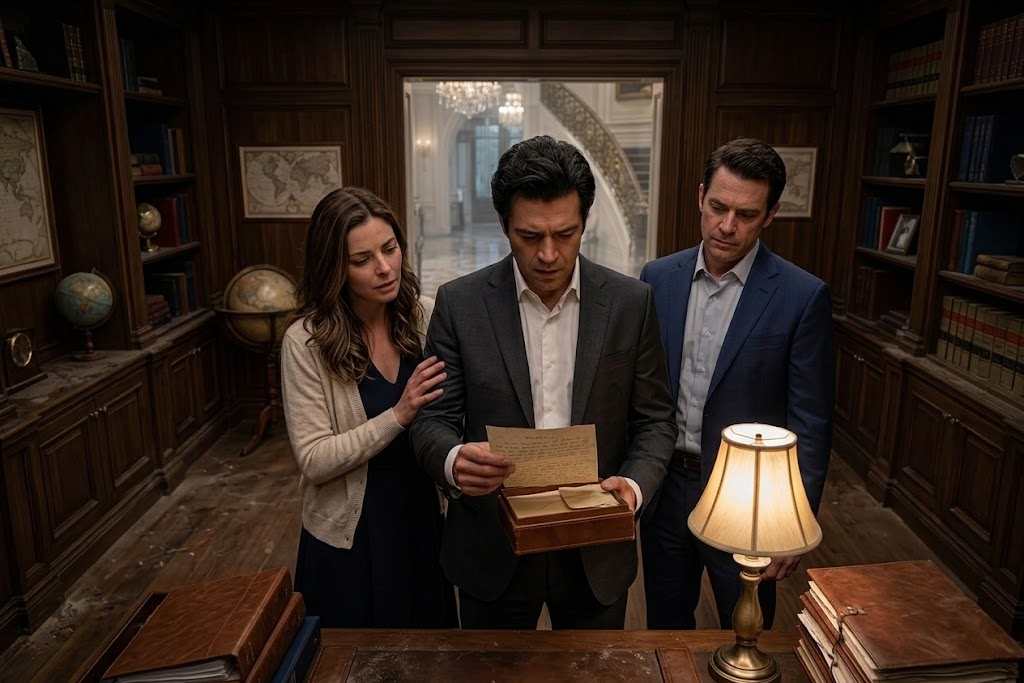
CHAPTER 4
THE LAST LETTER OF THOMAS HARRINGTON
Part 1/2
There are moments in life when a single discovery changes the way you see everything that came before it.
A photograph.
A conversation.
A letter.
A name written on a piece of paper.
Sometimes, the smallest things carry the heaviest truths.
That was what I learned the day we opened my grandfather’s office.
Because inside that room…
inside the place where Thomas Harrington spent decades building his empire…
was the final lesson he wanted his family to learn.
The old office had remained untouched for ten years.
Ten years.
Nobody entered.
Nobody moved anything.
Nobody changed the furniture.
It was as if the family believed opening that door meant admitting he was truly gone.
My father stood in front of the office door holding an old brass key.
I had seen that key before.
When I was a child, my grandfather always carried it.
I remembered asking him once:
“Grandpa, what does this key open?”
He smiled.
“Something important.”
“What?”
He tapped my forehead.
“Hopefully, someday… this.”
At the time, I laughed.
I thought he was joking.
Now I understood.
He wasn’t talking about a door.
He was talking about understanding.
Emily stood beside me.
She looked nervous.
That surprised me.
After everything she had faced…
Margaret’s accusations.
The family meeting.
The pressure.
The betrayal.
I expected her to be fearless.
But this was different.
This wasn’t about proving anything.
This was about opening a chapter of someone’s life.
Someone she respected deeply.
“You okay?”
I asked.
She nodded.
“Yes.”
But then she smiled slightly.
“Just remembering.”
“What?”
She looked at the door.
“Your grandfather.”
I had heard stories about my grandfather my entire life.
Everyone knew Thomas Harrington.
The businessman.
The founder.
The man who built the company.
But Emily knew another side.
The side nobody else saw.
“He was lonely.”
I looked surprised.
“My grandfather?”
She nodded.
“Yes.”
“Why?”
Emily looked at the door.
“Because everyone loved what he built.”
A pause.
“But not everyone understood him.”
That sentence stayed with me.
Because maybe that was the tragedy of Thomas Harrington.
He created something everyone wanted.
But he couldn’t guarantee the people around him valued what truly mattered.
My father unlocked the door.
The sound echoed.
A small click.
But it felt enormous.
The door opened.
The room smelled like old paper and wood.
Nothing had changed.
The large desk sat in the center.
The leather chair behind it.
The shelves full of books.
The framed photographs.
Everything exactly as he left it.
I stepped inside.
And for a moment…
I was ten years old again.
Sitting across from my grandfather.
Watching him write notes.
Listening to him explain why honesty mattered.
On the desk was a small wooden box.
My father walked toward it.
“That wasn’t there before.”
I looked at him.
“What do you mean?”
“When we closed the office after his death, this wasn’t here.”
Emily approached slowly.
On the box was a small note.
Three words.
For my family.
My father opened it.
Inside were several items.
A pocket watch.
An old photograph.
A small envelope.
And a key.
I picked up the photograph.
It showed my grandfather.
My father.
Margaret.
And me as a child.
Everyone smiling.
A family that looked perfect.
But I knew now.
Pictures only capture moments.
They don’t capture everything happening underneath.
My father picked up the envelope.
The handwriting made him freeze.
“What?”
I asked.
He looked emotional.
“It’s from him.”
My father handed it to Emily.
She looked confused.
“Why me?”
My father answered:
“Because it has your name.”
The envelope said:
Emily Carter.
Nobody spoke.
I watched my wife hold the letter.
The woman my aunt had spent years calling an outsider.
The woman whose name was now written by Thomas Harrington himself.
Emily opened it.
Her hands were shaking slightly.
She read silently.
Then her expression changed.
“What?”
I asked.
She looked at me.
“He knew.”
My father frowned.
“Knew what?”
Emily looked at the letter.
“He knew exactly what would happen.”
She began reading aloud.
Emily,
If you are reading this, then my greatest fear has become reality.
The room became silent.
My family has reached a point where they must choose between protecting their pride…
and protecting each other.
My father closed his eyes.
Because those words were painful.
Emily continued.
I want you to understand something.
You were never chosen because you were useful.
You were chosen because you were honest.
She stopped for a moment.
Her eyes became emotional.
Many people will carry the Harrington name.
But very few will understand what the name was supposed to represent.
I looked around the room.
Because suddenly the entire story became clearer.
This was never about a company.
It was about values.
Emily continued.
Margaret believes family is something inherited.
She believes blood gives someone the right to lead.
A pause.
But blood is only where a family begins.
It is not what keeps a family together.
Nobody spoke.
My father whispered:
“He knew.”
Emily nodded.
“He knew everything.”
The letter continued.
I watched Margaret grow.
She was brilliant.
She was ambitious.
She was determined.
Emily looked at Margaret’s name.
But somewhere along the way, she began confusing love with control.
Those words were powerful because they weren’t hateful.
They weren’t revenge.
They were simply the truth.
She wanted to prove she belonged so badly…
that she forgot belonging cannot be forced.
I thought about Easter.
About Sophia.
About Margaret saying:
“They don’t share our blood.”
My grandfather had seen the problem years before.
Then Emily reached the most important part.
Her voice became quieter.
The day may come when my family rejects the person who protects them.
If that happens, remember this:
The person standing alone is often the person standing for what is right.
Nobody moved.
Then came the final paragraph.
The one that changed everything.
Emily Carter,
I leave you the responsibility of protecting Harrington Industries.
Not because you are a Harrington.
But because you understand what a Harrington should be.
Emily stopped reading.
The room was silent.
My father looked at her.
“You knew?”
Emily shook her head.
“No.”
“Then why did you keep fighting?”
Emily looked at the letter.
“Because I made a promise.”
“What promise?”
She whispered:
“That I would protect what your grandfather built.”
At that moment…
I understood something.
Emily never wanted the Harrington name.
She had been protecting the meaning behind it.
Then my father noticed something inside the box.
A second document.
He picked it up.
His face changed.
“What?”
I asked.
He read silently.
Then looked at us.
“This changes everything.”
He handed it to me.
At the top was written:
SUCCESSION PROTECTION AGREEMENT
I read the first line.
And my heart stopped.
If any member of the Harrington family attempts to remove Emily Carter from her position or challenge her authority through personal interest, their ownership rights will be revoked.
I looked at my father.
“Grandpa planned for this.”
My father nodded slowly.
“He knew.”
Before we could say anything else…
my phone rang.
Margaret.
I answered.
“What?”
For several seconds, she said nothing.
Then:
“Michael.”
Her voice was different.
Not arrogant.
Not angry.
Broken.
“I need to see you.”
I almost refused.
But something stopped me.
“Why?”
A long silence.
Then she whispered:
“Because there is something I never told anyone.”
I looked at Emily.
She was watching me carefully.
“What?”
Margaret’s voice became quieter.
“Your grandfather didn’t know everything.”
My heart tightened.
“What are you talking about?”
She answered:
“There was another person involved.”
The room went silent.
“Who?”
Margaret took a breath.
Then said:
“Someone much closer than you think.”
The call ended.
I stared at my phone.
Because suddenly…
the story wasn’t over.
Someone else had been hiding something.
Someone else had been protecting a secret.
And this time…
it wasn’t Margaret.
END OF CHAPTER 4 — PART 1
Part 2/2
For several minutes after Margaret’s call ended, nobody spoke.
The silence inside my grandfather’s office felt heavier than before.
Not because we had discovered something new.
Because we realized there was still something we didn’t know.
And after everything my family had hidden…
I had learned one thing:
The truth rarely comes all at once.
It arrives piece by piece.
And every piece changes the picture.
My father looked at me.
“You shouldn’t meet her alone.”
I looked at him.
“Why?”
His expression changed.
“Because Margaret knows how to control conversations.”
I almost smiled.
“Funny.”
“What?”
“Everyone says that about her.”
My father looked down.
Because it was true.
For decades, Margaret Harrington had been the person who controlled the room.
The person who decided what people knew.
The person who decided what people believed.
But something had changed.
She no longer controlled the truth.
And that was something even Margaret couldn’t manipulate.
“I’ll go.”
Emily looked at me immediately.
“Michael.”
“I need answers.”
She was quiet.
Then she nodded.
“I know.”
That was another thing I loved about Emily.
She never tried to make decisions for me.
She trusted me.
Even when she was afraid.
I met Margaret that evening at the same restaurant where she had first tried to negotiate with me.
A quiet place.
Private.
Away from the Harrington estate.
Away from family.
Away from history.
When I arrived, she was already there.
But this time…
she looked different.
The woman sitting across from me was not the powerful aunt who had stood at the Easter table.
Not the woman who believed she owned every room she entered.
She looked tired.
“Thank you for coming.”
I sat down.
“You said there was something I needed to know.”
She nodded.
For a moment, she didn’t speak.
Then she said:
“I was wrong.”
I looked at her.
Those words surprised me.
Not because they fixed anything.
They didn’t.
But because Margaret Harrington was not someone who apologized easily.
“About what?”
She looked down.
“About Emily.”
I waited.
“I spent years believing she was trying to take something from us.”
A pause.
“But she was the only person trying to save us.”
I said nothing.
Because I wanted to hear what came next.
“Your grandfather knew I was struggling.”
She looked at me.
“Not financially.”
A pause.
“Emotionally.”
That surprised me.
“He knew I felt invisible.”
She laughed quietly.
“Can you believe that?”
I didn’t answer.
Because I could.
“My entire life, I watched my father build something everyone admired.”
She looked at her hands.
“And I wanted him to see me.”
There it was.
The wound beneath everything.
Not money.
Not power.
Not business.
Recognition.
“I thought if I became successful enough…”
She paused.
“…if I became powerful enough…”
Another pause.
“…then nobody could ignore me.”
I understood then.
Margaret wasn’t born cruel.
She became someone who believed control was the only way to avoid being forgotten.
“But you hurt people.”
I said.
Her eyes closed.
“I know.”
“You hurt my daughter.”
“I know.”
“You hurt Emily.”
Her voice broke.
“I know.”
The fact that she admitted it did not erase the pain.
But it mattered.
Because for the first time…
she wasn’t defending herself.
“Who else was involved?”
I asked.
Her expression changed.
The reason I was there.
The secret.
She took a deep breath.
“It wasn’t only me.”
My body became tense.
“Who?”
She looked at me.
“Your father.”
The words felt like a punch.
“No.”
She nodded.
“Yes.”
I stood slightly.
“You told me he knew.”
“I told you he knew about the problem.”
A pause.
“But I never told you the full story.”
I sat back down.
“Explain.”
Margaret looked out the window.
“Your father discovered what I was doing before your grandfather did.”
I couldn’t speak.
“He confronted me.”
“Then why didn’t he tell Grandpa?”
Margaret smiled sadly.
“Because he was scared.”
I immediately thought about Easter.
My father’s silence.
His inability to defend Sophia.
His inability to defend Emily.
“He protected you.”
Margaret said.
“What?”
“He protected you from the truth.”
I shook my head.
“No.”
“Michael.”
She looked at me.
“Your father has spent his entire life trying to keep this family from falling apart.”
“But he failed.”
She nodded.
“Yes.”
That was the painful truth.
Sometimes people can have good intentions…
and still cause damage.
I left the restaurant feeling lost.
Because I had spent my entire life seeing my father as the stable one.
The good one.
The reasonable one.
But now I understood.
He wasn’t innocent.
He was simply afraid.
When I returned home, Emily was waiting.
She knew immediately.
“What happened?”
I sat down.
“My father knew.”
She didn’t react.
Not because she wasn’t surprised.
Because she understood people.
“What else?”
I looked at her.
“How do you do that?”
“What?”
“How do you always know?”
She smiled sadly.
“Because people usually show you who they are.”
I told her everything.
Margaret’s confession.
My father’s involvement.
The years of silence.
When I finished, Emily was quiet.
Then she said:
“Your father made a mistake.”
I looked at her.
“That’s all?”
She nodded.
“But mistakes don’t define people.”
I stared at her.
“After everything they did to you…”
“You still defend them?”
She smiled.
“No.”
A pause.
“I understand them.”
That was the difference.
Emily didn’t excuse people.
She understood them.
The next morning, my father came to our house.
He didn’t bring documents.
He didn’t bring explanations.
He just came.
“I owe you the truth.”
He said.
I looked at him.
“Yes.”
He sat down.
And for the first time in my life…
my father looked small.
“I knew Margaret was making mistakes.”
He swallowed.
“I thought I could fix it.”
“How?”
“I thought if I helped stabilize things…”
A pause.
“…she would stop.”
“But she didn’t.”
“No.”
“Why didn’t you tell Grandpa?”
His eyes filled.
“Because he loved her.”
I said nothing.
“And because I was afraid.”
There it was.
The same thing that had controlled Margaret.
Fear.
“I thought telling the truth would destroy the family.”
My father whispered.
“But hiding it almost did.”
That sentence stayed with me.
Because it was the lesson my family needed.
After my father left, Emily and I sat together.
Neither of us spoke for a long time.
Then she said:
“Michael.”
“Yes?”
“Your grandfather knew.”
I looked at her.
“What?”
“He knew your father was afraid.”
She picked up the letter again.
“There is something else.”
She turned the page.
A paragraph we had missed.
To my son,
If you are reading this, then you have carried a burden that was never yours alone.
My father.
You believed silence would protect this family.
But silence only protects the person who caused the damage.
I stopped.
Because those words were exactly what my father needed to hear.
The letter continued.
I forgive you.
But forgiveness does not remove responsibility.
Emily looked at me.
My grandfather wasn’t trying to punish anyone.
He was trying to teach them.
Then came the final part.
Michael,
There will come a day when you must decide what kind of family you want to build.
One based on inheritance.
Or one based on love.
I closed my eyes.
Because I finally understood.
The Easter dinner.
The $500 envelope.
The humiliation.
The betrayal.
All of it led to one question.
What makes someone family?
A last name?
No.
A shared history?
Not always.
Blood?
Not enough.
The answer was much simpler.
Someone who stays.
Someone who protects.
Someone who chooses you.
Three days later, the Harrington family gathered again.
But this time…
it wasn’t for business.
It wasn’t for tradition.
It wasn’t because Margaret called everyone together.
It was because everyone needed to decide what happened next.
Margaret stood before the family.
No confidence.
No performance.
Just honesty.
“I hurt people.”
She said.
“I wanted power more than I wanted family.”
Nobody interrupted.
“I cannot change what I did.”
A pause.
“But I can choose what I do now.”
She turned toward Emily.
“I don’t expect forgiveness.”
Emily nodded.
“Good.”
Everyone looked surprised.
Emily continued.
“Because forgiveness is not something you demand.”
A pause.
“It’s something you earn.”
Margaret nodded.
“I understand.”
And for the first time…
I believed her.
But there was still one final decision.
The future of Harrington Industries.
The company my grandfather built.
The company my family almost destroyed.
The lawyer entered the room.
The final documents were ready.
Everyone became silent.
He opened the folder.
“Thomas Harrington left one final instruction.”
He looked at Emily.
“The future of Harrington Industries will not belong to the person with the strongest claim.”
A pause.
“It will belong to the person who proves they understand what family means.”
Everyone looked at Emily.
But she didn’t look happy.
She looked thoughtful.
Because Emily never wanted power.
The lawyer continued:
“And that person has one final choice to make.”
The room became silent.
Emily looked at me.
Then at my children.
Then at the family.
And I knew.
The final chapter wasn’t about Margaret anymore.
It wasn’t about the company.
It was about the choice Emily had to make.
Would she take the power everyone believed she wanted?
Or would she choose something completely different?
END OF CHAPTER 4
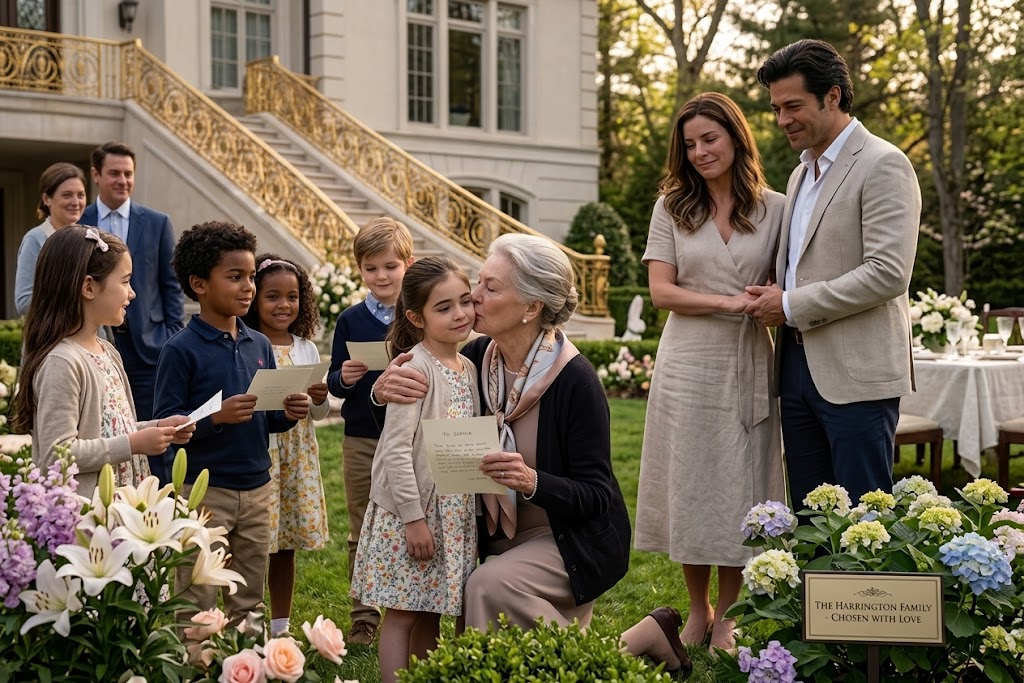
CHAPTER 5
THE FAMILY WE CHOOSE
Part 1/2
There is a moment in every family when the past finally catches up with the present.
A moment when everyone has to stop explaining.
Stop defending.
Stop pretending.
And simply decide who they want to become.
For the Harrington family, that moment came inside the same room where so many decisions had been made before.
The conference room.
The room where my grandfather built his empire.
The room where Margaret tried to protect her power.
The room where Emily was once called an outsider.
But this time…
nobody was there to fight.
They were there to choose.
The lawyer placed the final documents on the table.
Everyone was silent.
My father.
My mother.
Margaret.
The board members.
The entire Harrington family.
Everyone was waiting for Emily.
I watched my wife carefully.
Most people would have expected her to be excited.
She had spent years being underestimated.
Years being ignored.
Years being treated as someone who didn’t belong.
Now she had the one thing everyone thought she wanted.
Authority.
Respect.
Power.
But Emily wasn’t smiling.
She wasn’t celebrating.
Because power had never been her goal.
And that was something my family finally understood.
The lawyer cleared his throat.
“According to Thomas Harrington’s final instructions, Emily Carter has the authority to decide the future direction of Harrington Industries.”
Margaret looked down.
I noticed something.
A year ago, she would have been angry.
She would have argued.
She would have fought.
But today…
she simply accepted it.
The lawyer continued.
“However, Thomas Harrington included one final condition.”
Everyone looked up.
“He wanted Emily to answer one question before accepting this responsibility.”
Emily frowned.
“What question?”
The lawyer opened the letter.
Then read:
If you are given the power to punish those who hurt you, what will you choose to do?
Nobody moved.
I understood immediately.
This wasn’t a business decision.
It was a test of character.
The same test my grandfather had been talking about all along.
Emily looked around the room.
At the people who had doubted her.
At the people who had ignored her.
At the people who had hurt her.
Then she spoke.
“I don’t want to punish anyone.”
Everyone looked surprised.
Margaret slowly looked up.
Emily continued.
“Punishment is easy.”
A pause.
“Building something better is harder.”
Those words were Emily.
Completely Emily.
“I accept the responsibility.”
She said.
“But not because I want control.”
She looked at the company documents.
“I accept because this company represents thousands of people.”
She looked at my father.
“My grandfather-in-law built something that provided opportunities for families.”
Then she looked at Margaret.
“And I don’t want one person’s mistakes to destroy what many people worked for.”
The room was silent.
The lawyer nodded.
“Then the authority is officially transferred.”
And just like that…
Emily Carter became the person responsible for the future of Harrington Industries.
The woman who was once treated like a guest…
became the person everyone trusted to lead.
But that wasn’t the moment that changed me.
The real moment came later.
When Emily made her first decision.
Everyone expected her to remove Margaret.
After everything.
After the betrayal.
After the damage.
Nobody would have blamed her.
But Emily did something nobody expected.
She asked Margaret to stay.
The room went silent.
Even Margaret looked confused.
“What?”
Emily looked at her.
“I want you to stay.”
Margaret shook her head.
“Why?”
Emily answered honestly.
“Because you know this company.”
Margaret looked uncomfortable.
“You trust me?”
Emily paused.
Then said:
“I trust that people can change.”
That was not the same as saying she trusted Margaret completely.
And Margaret understood.
“You don’t forgive me yet.”
Margaret said.
Emily shook her head.
“No.”
Everyone looked surprised.
“But I believe you can become someone better.”
Margaret looked away.
And for the first time…
I saw something I never expected.
Humility.
“I don’t know how to do that.”
Margaret whispered.
Emily smiled slightly.
“Start by listening.”
A simple sentence.
But for Margaret…
it was probably the hardest lesson of her life.
The company moved forward.
The investigation continued.
The legal consequences were handled properly.
Margaret accepted responsibility for what she had done.
She stepped away from her previous position.
She paid back what she could.
She cooperated fully.
But the most important change did not happen in the company.
It happened in the family.
Three months later, Easter came again.
I almost didn’t want to go.
Not because I hated the Harrington family.
Because memories are complicated.
Some places hold happiness.
Some places hold pain.
And sometimes…
they hold both.
Sophia was excited.
She was wearing another yellow dress.
Different from the one she wore the year before.
But similar.
Emily noticed.
“You like yellow?”
Sophia smiled.
“It feels happy.”
That answer broke my heart.
Because I knew what the first yellow dress represented.
The day she learned rejection.
Now…
she was choosing happiness.
When we arrived at the estate, Margaret was waiting outside.
Not at the door.
Not standing like the owner of the house.
She was standing in the garden.
Waiting.
Sophia held my hand.
I felt her grip tighten.
She remembered.
Margaret noticed.
And I saw pain cross her face.
Not because Sophia was afraid.
Because Margaret finally understood why.
She knelt down.
“Sophia.”
My daughter looked at her.
“Hi.”
Margaret took a breath.
“I owe you an apology.”
Sophia looked confused.
“For what?”
Margaret looked at the ground.
“For making you feel like you didn’t belong.”
Nobody spoke.
“I was wrong.”
Margaret continued.
“I said something that hurt you.”
A pause.
“And I cannot take it back.”
Sophia looked at her.
“Why did you say it?”
That question again.
The same innocence.
The same honesty.
Margaret answered:
“Because I forgot something important.”
“What?”
She smiled sadly.
“That family isn’t about who shares your blood.”
Sophia waited.
“It’s about who loves you.”
My eyes became wet.
Because that was the exact lesson Margaret had spent years refusing to learn.
Sophia looked at Emily.
Then at me.
Then back at Margaret.
“Am I family now?”
Margaret closed her eyes.
That question hurt her.
Because she knew the answer should have always been obvious.
“Yes.”
Her voice broke.
“You always were.”
Sophia studied her.
“But you didn’t think so before.”
Margaret nodded.
“No.”
A tear rolled down her face.
“I was wrong.”
Then something happened.
Something nobody expected.
Sophia hugged her.
Margaret froze.
Like she didn’t know what to do.
Then slowly…
she hugged her back.
And standing there…
watching my daughter hug the woman who had hurt her…
I realized something.
Forgiveness wasn’t forgetting.
It wasn’t pretending the pain never happened.
It was choosing not to let pain decide the future.
That evening, we sat around the same Easter table.
The same table from one year earlier.
The same place where everything broke.
But everything was different.
Margaret stood.
Everyone became quiet.
For a second, I remembered the previous Easter.
The envelopes.
The silence.
The humiliation.
But this time, she wasn’t holding a velvet purse.
She was holding letters.
“I want to start a new tradition.”
She said.
She handed each child a letter.
Not money.
Not gifts.
Words.
Sophia opened hers.
Inside were handwritten sentences.
You are loved.
You belong here.
You never have to earn your place.
Sophia looked up.
Margaret smiled.
“Every child deserves to hear that.”
I looked around the table.
My family.
Not perfect.
Not fixed completely.
But trying.
And maybe that was the most important thing.
Because real families aren’t perfect.
They hurt each other.
They make mistakes.
They fail.
But the strongest families are the ones willing to face the truth.
Later that night, after everyone left, Emily and I walked through the garden.
The same garden where she had once been treated like a stranger.
“You okay?”
I asked.
She smiled.
“Yes.”
I laughed.
“You still say that.”
She smiled.
“I know.”
We stood there quietly.
Then I said:
“You realize something?”
“What?”
“A year ago, I thought walking away from that house meant losing my family.”
Emily looked at me.
“But I was wrong.”
I smiled.
“That was the day I finally found it.”
She held my hand.
Because that was the truth.
The Easter dinner didn’t destroy my family.
It revealed it.
END OF CHAPTER 5 — PART 1
Part 2/2 — THE FINAL LETTER
People often believe the most important moments in life are the loud ones.
The arguments.
The confrontations.
The moments when someone finally says what everyone has been afraid to say.
But looking back now…
I think the most important moments are usually the quiet ones.
A hand held.
A door opened.
A person choosing to stay.
A year after that Easter dinner, I finally understood something my grandfather had tried to teach us.
Family is not tested when everything is easy.
Anyone can love during good times.
Anyone can sit at a beautiful table.
Anyone can smile when there is nothing to lose.
The real test comes when someone has the opportunity to walk away…
and chooses not to.
For a long time, I thought that Easter Sunday was the day my family broke apart.
I thought Margaret destroyed everything.
I thought those words—
“They don’t share our blood.”
—were the moment everything changed.
But I was wrong.
That was not the day my family broke.
That was the day the pretending stopped.
Before that day, we were a family that looked perfect from the outside.
The Harrington name.
The mansion.
The company.
The traditions.
The history.
Everything people admired.
But inside…
we were broken.
We had confused inheritance with love.
We had confused reputation with character.
We had confused sharing blood with being family.
And it took a seven-year-old girl standing at a dinner table…
to show us how wrong we were.
Several months after the Easter dinner, Harrington Industries began changing.
Not overnight.
Not magically.
Real change rarely happens that way.
It happens slowly.
Through decisions.
Through uncomfortable conversations.
Through people admitting when they are wrong.
Emily changed the company completely.
Not by becoming another version of Margaret.
Not by becoming someone obsessed with control.
She did it by remembering what my grandfather cared about.
People.
The first thing she did was meet employees.
Not executives.
Not investors.
Employees.
The people who had worked there for twenty, thirty, forty years.
The people who built the company with their hands.
One employee named Robert had worked at Harrington Industries for thirty-five years.
He was a construction supervisor.
A man who had never been invited to family events.
Never appeared in company magazines.
Never sat in important meetings.
Emily invited him into her office.
He looked nervous.
He thought he was in trouble.
Instead, she asked him:
“What do you think we are doing wrong?”
He stared at her.
Nobody had ever asked him that before.
That was Emily’s leadership.
She didn’t believe the person with the highest title had all the answers.
She believed the person closest to the problem often understood it best.
The company recovered.
Slowly.
But honestly.
And something unexpected happened.
The Harrington name became stronger.
Not because we protected the reputation.
Because we rebuilt the trust.
As for Margaret…
her journey was harder.
Change was harder for her than anyone.
Because Margaret had spent her entire life believing admitting weakness meant losing.
The first time she apologized publicly, she struggled.
She stood in front of the employees and said:
“I spent years believing leadership meant being the person everyone followed.”
She paused.
“I was wrong.”
Nobody spoke.
“I learned that leadership means being responsible for the people who follow you.”
It wasn’t perfect.
Some people never forgave her.
And that was something she had to accept.
Emily once told me:
“Forgiveness doesn’t mean everyone has to forget.”
That was important.
Because healing does not mean pretending the wound never happened.
It means refusing to let the wound control the future.
My father changed too.
That might have been the biggest surprise.
Because for years, I thought he was the weakest person in the family.
The man who stayed silent.
The man who avoided conflict.
The man who chose comfort over truth.
And maybe he had been.
But people are more complicated than their worst moments.
One evening, my father came to my house.
We sat in the backyard.
Just the two of us.
“I failed you.”
He said.
I looked at him.
“That’s not easy to admit.”
He nodded.
“No.”
A pause.
“But it’s necessary.”
He told me something I would never forget.
“I spent my life trying to prevent this family from falling apart.”
He looked toward the house.
“But I didn’t realize silence was also a way of breaking it.”
That was the lesson everyone learned.
Not just Margaret.
Everyone.
A year later, Easter came again.
And once again, we gathered at the Harrington estate.
But this time, something was different.
There were no expectations.
No pressure.
No performance.
Just family.
The children ran through the garden.
Sophia and Liam chased their cousins.
They laughed.
They played.
They didn’t think about blood.
They didn’t think about names.
They were simply children.
I watched Sophia for a moment.
The same little girl who once stood alone at the table.
Now she was running through the garden of the same house where she had questioned whether she belonged.
Emily came beside me.
“You’re thinking again.”
I smiled.
“You always know.”
She laughed.
“After twelve years, yes.”
I looked at our daughter.
“Do you ever think about that day?”
Emily was quiet.
“Sometimes.”
“Does it still hurt?”
She thought about it.
“Less.”
I looked at her.
“Why?”
She smiled.
“Because that day taught us something.”
“What?”
She looked toward our children.
“That we don’t need everyone to choose us.”
A pause.
“We only need the right people to.”
I held her hand.
After dinner, Margaret asked to speak with me.
I followed her outside.
For a moment, I saw the old Margaret.
The woman who controlled everything.
But only for a moment.
“I want to thank you.”
She said.
I smiled slightly.
“For what?”
“For not giving up on me.”
I looked surprised.
“Margaret…”
She shook her head.
“No.”
She looked toward the house.
“I know I don’t deserve what this family gave me.”
I didn’t answer.
“But you taught me something.”
“What?”
She smiled sadly.
“That people can be held accountable and still be loved.”
That was something Margaret had never understood.
She thought mistakes meant rejection.
She thought weakness meant losing value.
She thought people were either worthy or unworthy.
But Emily taught all of us something different.
People are not defined only by what they did.
They are also defined by what they choose afterward.
Before we left that night, my father handed me one final envelope.
I looked at him.
“Another one?”
He smiled.
“Your grandfather planned everything.”
I opened it in the car.
Inside was one final letter.
The handwriting was familiar.
Michael,
I stopped.
Because even after all this time…
seeing his handwriting still felt impossible.
If you are reading this, then you have discovered the truth about your family.
But I hope you have discovered something more important.
I continued.
A family is not measured by the number of people who share your name.
It is measured by the number of people who would stand beside you when your name means nothing.
I felt my eyes become heavy.
Wealth will disappear.
Businesses will change hands.
Houses will belong to someone else someday.
A pause.
But the love you give and the kindness you show…
those are the only things you truly leave behind.
I looked at Emily.
At my children.
At the family we had built.
The final sentence was simple.
Michael, remember this:
Blood creates relatives.
Love creates family.
I folded the letter.
And I finally understood.
The Easter dinner was never about a $500 envelope.
It was never about inheritance.
It was never about who carried the Harrington bloodline.
It was about a little girl learning whether she was loved.
It was about a woman proving that kindness was stronger than pride.
It was about a family discovering that the person they rejected…
was the person who saved them.
Years later, people would still talk about the Harrington family.
They would talk about the company.
The mansion.
The legacy.
But the thing I remembered most…
was not the wealth.
Not the power.
Not the name.
It was my daughter’s hand in mine as we walked away that night.
It was Emily standing beside me.
It was the choice we made.
We chose dignity.
We chose love.
We chose each other.
And that was the day I finally learned:
Family is not always the one you are born into.
Sometimes…
it is the one you fight to protect.
THE END