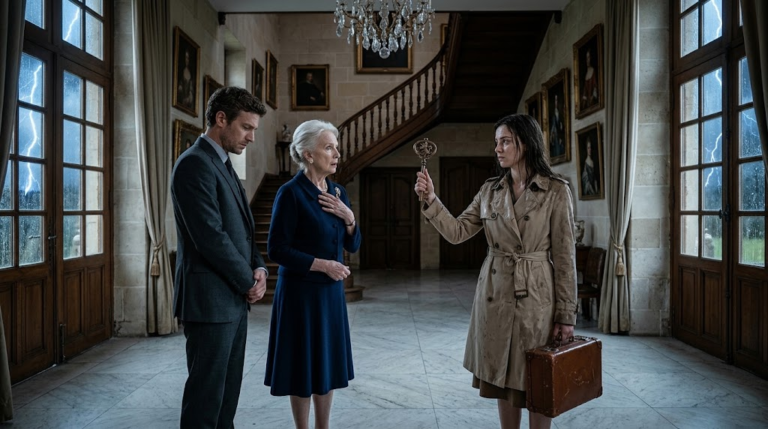
PART 1 — “YOUR MOTHER ISN’T STAYING HERE ANYMORE.”

Rachel Bennett knew something was wrong the second she opened the front door and didn’t smell her mother’s cinnamon chicken roasting in the kitchen. After four days in Chicago negotiating the biggest contract of her career, she had pictured coming home to Helen complaining that Rachel was too thin, Mark pretending not to steal potatoes from the pan, and the three of them laughing around the long walnut table beneath the chandelier. Instead, the Greenwich mansion was unnaturally quiet, Helen’s blue gardening shoes were missing from the mudroom, and two framed photographs had vanished from the hallway. Rachel dropped her suitcase beside the stairs and called for her mother.
“Mom?”
No answer.
“Mom, I’m home.”
Mark appeared at the entrance to the study holding a whiskey glass. He looked irritatingly calm, still wearing the white dress shirt he usually changed out of the moment he returned from work, and there was something almost rehearsed about the way he leaned against the doorframe. Rachel’s stomach tightened when he didn’t smile at her. Then she noticed three cardboard boxes stacked beside the coat closet.
“Where’s Mom?”
Mark took a drink.
“Your mother isn’t staying here anymore.”
Rachel stared at him.
“What?”
“I said Helen isn’t living here anymore.”
For several seconds Rachel genuinely thought she had misunderstood him. Helen Bennett was seventy-one, still independent, fiercely proud, and had moved into the mansion eighteen months earlier after hip surgery only because Rachel had begged her to stop living alone. Helen contributed to groceries, cooked more often than anyone asked, kept mostly to her downstairs suite, and spent half her days volunteering at a literacy center. She and Mark occasionally disagreed, but Rachel had never imagined those disagreements could lead to this.
“Where is she?”
Mark sighed.
“Rosewood Senior Residence.”
Rachel’s face went blank.
“You put my mother in a nursing home?”
“It’s assisted living.”
“You put my mother in assisted living while I was out of town?”
“She needed somewhere appropriate.”
Rachel stepped toward him.
“Appropriate for what?”
Mark’s jaw tightened.
“For her behavior.”
“What behavior?”
“She goes through things. She asks questions about bills that aren’t hers. She tells the staff what to do. She criticized how I manage this house in front of people.”
Rachel blinked.
“You manage this house?”
“You know what I mean.”
“No, Mark. I really don’t.”
He set his glass on the console table with more force than necessary. For ten years of marriage, Rachel had watched him become successful, polished, and increasingly certain that every room belonged to him the moment he entered it. She had mistaken that confidence for stability because she had grown up watching Helen count grocery coupons after Rachel’s father died. Standing in the foyer now, Rachel felt something shift inside her marriage.
“Did Mom agree to go?”
Mark looked away.
Rachel’s voice dropped.
“Did she agree?”
“She signed the intake papers.”
“That wasn’t my question.”
“She was being impossible.”
Rachel pulled out her phone.
“I’m calling her.”
Mark stepped closer.
“Rachel, don’t turn this into some huge scene.”
She looked up.
“You removed my seventy-one-year-old mother from her home while I was on a business trip.”
“Your home.”
“What?”
Mark gave a humorless laugh.
“This is our home. Not Helen’s.”
Rachel stared at him.
“And because you think that, you decided you could throw her out?”
“I didn’t throw anyone out.”
“What do you call packing her belongings into boxes?”
“She was making this marriage unbearable.”
Rachel stopped.
“Our marriage?”
Mark’s expression softened just enough to feel manipulative.
“We never have privacy anymore. Every decision gets Helen’s opinion. Every argument becomes a family meeting. I married you, Rachel. Not your mother.”
For half a second, guilt pierced through Rachel’s anger. Helen did have opinions, often loudly stated, and there had been moments when Rachel wished her mother would allow her to make mistakes without predicting them first. But those moments didn’t explain why Mark had waited until Rachel left the state. They didn’t explain the boxes, the missing photographs, or why Mark seemed more relieved than ashamed.
“You should have called me.”
“You would have stopped me.”
“Yes.”
“Exactly.”
The doorbell rang.
Neither of them moved.
Mark frowned.
“Are you expecting someone?”
Rachel shook her head.
The bell rang again.
Mark walked toward the door, opened it, and immediately stiffened.
A silver-haired man stood outside wearing a charcoal suit and carrying a leather briefcase. Rachel recognized him instantly as Arthur Cole, the attorney who had handled her father’s estate more than twenty years earlier. She hadn’t seen him since Helen’s seventieth birthday dinner.
“Arthur?”
Arthur looked at Rachel, then at Mark.
“I’m sorry to arrive unannounced.”
Mark folded his arms.
“This isn’t a good time.”
Arthur stepped across the threshold anyway.
“Actually, Mr. Bennett, the timing is precisely why I’m here.”
Mark’s expression hardened.
“What does that mean?”
Arthur placed his briefcase on the dining table and removed a thick blue folder.
Across the front was a handwritten notation.
Rachel could not read it from where she stood.
Arthur looked at her.
“Rachel, where is your mother?”
“Rosewood.”
Arthur’s expression changed instantly.
“She went?”
Rachel frowned.
“You knew?”
“I knew Mr. Bennett was pressuring her.”
Mark laughed.
“Pressuring her? She signed voluntarily.”
Arthur opened the folder.
“Did she?”
Mark’s smile faded.
Arthur removed several documents, arranged them carefully, and pushed one toward Mark.
“What is this?”
Mark barely glanced down.
“A deed.”
“Read the owner’s name.”
Mark looked annoyed.
Then he read.
His expression changed.
Rachel stepped closer.
“What?”
Mark said nothing.
Arthur turned the paper toward her.
At the top of the ownership record were four words Rachel had never seen associated with the mansion.
HELEN MARIE CARTER TRUST.
Rachel looked at Arthur.
“What is that?”
Arthur met her eyes.
“The legal owner of this property.”
Mark laughed too quickly.
“That’s ridiculous.”
Arthur remained calm.
“It isn’t.”
“We bought this house.”
“You live in this house.”
“I put money into it.”
“That doesn’t make you the owner.”
Mark’s voice rose.
“My name is on the mortgage.”
Arthur shook his head.
“There is no mortgage.”
Rachel turned sharply toward Mark.
“What?”
Mark stared at the document again.
Arthur continued.
“The property was purchased in cash nine years ago by a trust controlled exclusively by Helen Carter.”
Rachel felt dizzy.
Nine years.
She and Mark had moved into the mansion nine years earlier after Mark told her his investments had finally paid off. He had allowed Rachel to believe the down payment came from his business and that they had been making mortgage payments together ever since. Rachel had transferred thousands of dollars every month into the household account.
“Mark…”
He didn’t look at her.
Arthur removed another document.
“The trust pays property taxes.”
Another.
“The trust paid for the original purchase.”
Another.
“The trust funded the structural renovation.”
Rachel whispered.
“Why?”
Arthur looked at her.
“Your mother wanted you protected.”
Mark slammed his palm against the table.
“This is insane.”
Arthur’s expression remained unchanged.
“No, Mr. Bennett. What may be insane is removing the legal owner of a property from her own residence and representing yourself as the owner.”
Mark’s face drained.
Rachel remembered Helen once mentioning The Hidden Deed after too much wine on Thanksgiving, laughing that every woman should understand exactly whose name was on the paper beneath the fancy paint. Rachel had thought it was one of her mother’s strange little sayings. Now The Hidden Deed sat between them like a loaded weapon.
Mark looked at Rachel.
“You knew about this?”
“No.”
“Your mother set me up.”
Arthur closed the folder halfway.
“Mr. Bennett, Helen did not set you up.”
“Then why hide it?”
Arthur stared at him.
“She wasn’t hiding it from you.”
The room fell silent.
“She was hiding it from Rachel.”
Rachel’s breath caught.
“Why?”
Arthur looked almost apologetic.
“Because your mother was waiting for the right moment to tell you where the money really came from.”
Mark stopped moving.
Rachel noticed.
That was the first moment all evening when he looked genuinely frightened.
Arthur noticed too.
“Mr. Bennett, perhaps you already know.”
Rachel turned toward her husband.
“Know what?”
Mark reached for his whiskey.
His hand trembled.
Then headlights swept across the front windows.
A black sedan stopped outside.
Arthur looked toward the door.
Rachel’s heart pounded.
“Who is that?”
Arthur slowly closed The Hidden Deed folder.
“Your mother.”
The door opened.
Helen stepped inside wearing the same navy coat Rachel had bought her last Christmas.
She was not alone.
Behind her stood two police detectives.
And when Mark saw them, the whiskey glass slipped from his hand and shattered against the hardwood floor.
PART 2 — THE MONEY BENEATH THE HOUSE

Helen did not look like a woman who had been thrown out of her home. She looked tired, certainly, and there was a purple bruise blooming beneath the sleeve of her coat where someone had gripped her arm too hard, but her back was straight and her eyes were sharper than Rachel had seen them in months. One detective remained near the doorway while the other quietly spoke to Arthur. Mark stared at Helen as though she had returned from the dead.
Rachel rushed toward her.
“Mom.”
Helen opened her arms.
Rachel collapsed into them.
“I’m sorry.”
Helen held her tighter.
“You didn’t do this.”
“I should’ve known.”
“You were working.”
“I should have called more.”
Helen pulled back.
“Rachel.”
Her voice was firm.
“Stop accepting responsibility for things men decide to do behind your back.”
Mark laughed bitterly.
“There it is.”
Rachel turned.
Mark continued.
“Everything is always some man’s fault with her.”
Helen looked at him.
“No.”
She removed her coat.
“Just tonight’s problems.”
Rachel saw the bruise.
Her expression changed instantly.
“What happened to your arm?”
Helen looked down.
“Mark’s driver helped me into the car.”
Mark snapped.
“I never told him to hurt you.”
Helen stared at him.
“You told him I was confused and might resist.”
Rachel slowly turned toward her husband.
“Confused?”
Mark’s voice became defensive.
“She was causing a scene.”
“At her own house?”
“I didn’t know it was her house!”
Helen smiled sadly.
“That’s the interesting thing about The Hidden Deed, Mark. You never bothered to ask.”
Arthur opened the folder again. Inside were bank records, property documents, trust certificates, and several pages Rachel didn’t recognize. The detective glanced toward Mark as Arthur removed a red-tabbed section. Mark’s confidence cracked a little further.
Rachel looked at her mother.
“Why didn’t you tell me?”
Helen sat down.
“Because your father asked me not to.”
Rachel froze.
“My father?”
Helen nodded.
“Sit down.”
Rachel did.
Mark remained standing.
Helen looked at him.
“You should probably sit too.”
“I’m fine.”
“You won’t be.”
Mark’s face tightened.
Helen waited until Rachel was settled before she began. Twenty-two years earlier, Rachel’s father, Samuel Carter, had discovered that his construction company’s accountant was stealing from him. Samuel managed to recover much of the money, sell his stake, and move the proceeds into a private trust shortly before he died unexpectedly from an aneurysm. The total had grown quietly over the years.
“How much?”
Helen looked at Arthur.
Arthur answered.
“Approximately six-point-eight million dollars today.”
Rachel stared.
Mark stopped breathing.
Helen continued.
“Your father didn’t want you to grow up believing money would rescue you.”
Rachel looked around the mansion.
“So you bought this?”
“Yes.”
“Why?”
“Because you called me nine years ago crying.”
Rachel remembered.
Mark’s first company had collapsed after an investor backed out, and they had been living in a two-bedroom rental with a baby and another child on the way. Rachel had been terrified they would never recover. Two months later, Mark announced an investment had turned around and surprised her with the mansion.
Rachel looked at Mark.
“You said you bought it.”
Mark swallowed.
Helen answered for him.
“He knew I was providing the money.”
Rachel felt her chest tighten.
“What?”
Mark shook his head.
“That’s not what happened.”
Helen reached into The Hidden Deed folder and removed a letter.
“You signed this.”
Mark didn’t move.
Rachel took it.
It was a confidentiality agreement.
Mark Bennett agreed not to disclose the Carter Trust’s ownership of the property until Helen determined Rachel was financially and emotionally ready to inherit control.
Rachel reread the signature.
Mark’s.
Nine years earlier.
“You knew.”
Mark looked at her.
“I was trying to protect your pride.”
“My pride?”
“You were already ashamed that we needed help.”
“So you let me believe you saved us?”
Mark raised his voice.
“What difference did it make? We were married.”
Rachel stood.
“It made every difference.”
For years she had admired him for pulling them through their hardest period. She had tolerated his arrogance because she believed he had earned it by building a successful life from failure. Now Rachel understood that the moment she had fallen most deeply in love with her husband’s strength had been built on her mother’s silence.
Arthur interrupted.
“There’s another issue.”
Mark’s jaw clenched.
Rachel looked at the detective.
“What issue?”
Arthur removed a bank document.
“Three weeks ago, someone attempted to borrow two-point-three million dollars against this property.”
Rachel stared at Mark.
Mark shook his head immediately.
“That application never went through.”
Helen’s eyes narrowed.
“That isn’t a denial.”
Mark looked toward the detective.
“I want a lawyer.”
Arthur almost smiled.
“I strongly recommend one.”
Rachel’s voice trembled.
“You tried to mortgage a house you knew didn’t belong to you?”
“It was supposed to be temporary.”
“For what?”
Mark remained silent.
“Mark.”
Nothing.
Helen looked at Rachel.
“Your husband’s company is bankrupt.”
Rachel’s face went blank.
Mark shouted.
“It is not bankrupt!”
Arthur pushed another document across the table.
Technically, Bennett Strategic Holdings had not yet filed. But it owed nearly four million dollars to lenders, vendors, and private investors. Mark had hidden those liabilities using shell companies and short-term loans.
Rachel stared at the pages.
“How long?”
“Eighteen months,” Arthur said.
Rachel felt sick.
Mark stepped toward her.
“I was fixing it.”
“With my mother’s house?”
“Our house!”
Helen slammed her palm on the table.
“No.”
Everyone fell silent.
“It was never your house.”
Mark stared at her.
Helen continued.
“You slept under its roof. You raised children here. You were welcomed here.”
She pointed toward The Hidden Deed.
“But welcome is not ownership.”
The detective asked Mark to step aside.
Mark refused.
Rachel watched the man she had loved for twelve years become smaller with every passing minute.
Then his phone vibrated.
He instinctively reached for it.
The screen illuminated.
Rachel saw a preview.
Lydia: Did Helen sign it? Call me. We need to leave before morning.
Rachel’s blood went cold.
“Who’s Lydia?”
Mark locked the phone.
“No one.”
Helen closed her eyes.
Rachel looked at her mother.
“You know.”
Helen nodded.
“Unfortunately.”
“Who is she?”
Mark stepped forward.
“Rachel, don’t.”
Helen looked at him.
“You had several opportunities to be honest.”
Then she looked at her daughter.
“Lydia Crane is Mark’s attorney.”
Rachel exhaled in relief without understanding why.
Helen wasn’t finished.
“And she’s been sleeping with your husband for eight months.”
Rachel’s face emptied.
Mark immediately spoke.
“That’s not true.”
Helen opened a second folder.
Rachel stared at it.
Helen said quietly:
“I hoped it wasn’t.”
Inside were hotel receipts.
Photographs.
Messages.
One photograph showed Mark kissing a dark-haired woman outside a hotel in Boston.
Rachel didn’t cry.
She simply sat.
Mark rushed toward her.
“Rachel, listen to me.”
She raised one hand.
He stopped.
Rachel picked up The Hidden Deed and placed it between them.
For twelve years, she had thought the greatest danger to her marriage would be losing love.
She had been wrong.
The greatest danger was discovering how much of that love had depended on believing lies.
Then Arthur spoke.
“Rachel, there is one final clause in the trust.”
Helen looked at him sharply.
“Arthur.”
Rachel turned.
“What clause?”
Arthur hesitated.
Helen closed her eyes.
Rachel understood immediately.
“There’s another secret.”
Arthur nodded.
“The ownership of this mansion changes automatically if Helen is removed from the property through coercion.”
Mark stared.
“Changes to who?”
Arthur looked directly at Rachel.
“You.”
Nobody moved.
“As of 4:17 this afternoon, Rachel Bennett became the sole beneficiary and controlling trustee.”
Mark’s mouth fell open.
Rachel slowly turned toward him.
The confidence he had walked into the evening with was gone.
He wasn’t standing in the home he believed he controlled anymore.
He was standing inside his wife’s house.
And she had just discovered he planned to steal against it and leave with another woman.
PART 3 — WHAT HELEN NEVER TOLD HER DAUGHTER

The detectives did not arrest Mark that night because Arthur’s evidence still needed to be reviewed, but they warned him not to destroy financial records or contact Helen about her statement. Rachel told Mark to leave before the officers were halfway through explaining. He stared at her as though she were bluffing, perhaps because she had forgiven smaller betrayals so many times that he had mistaken patience for weakness. Then Rachel opened the front door.
“Go.”
“Rachel.”
“Leave.”
“This is my family.”
“You remembered that too late.”
Mark looked toward the staircase.
“What about the kids?”
“They’re at my sister’s tonight.”
“You planned this?”
Helen spoke from behind Rachel.
“I did.”
Mark’s eyes flashed.
“You’ve been poisoning her against me for years.”
Helen shook her head.
“If I had, she would have left sooner.”
Mark laughed bitterly.
“You always hated me.”
Helen’s face softened unexpectedly.
“No.”
That seemed to surprise everyone.
“I loved you once.”
Mark stared at her.
“You were the father of my grandchildren.”
Helen swallowed.
“I wanted you to become the man Rachel thought you were.”
Mark’s expression cracked for a moment.
Then he walked out.
The mansion felt enormous after the door closed. Rachel remained in the foyer staring at the empty space as though Mark might return and reveal the evening had been some elaborate misunderstanding. Helen quietly began gathering pieces of broken glass. Rachel watched her for several seconds before taking the broom away.
“Stop cleaning.”
Helen looked up.
“I don’t know what else to do.”
Rachel laughed once.
“Apparently neither do I.”
For the next hour they sat at the kitchen island while Arthur organized documents. Rachel asked questions in waves, sometimes calmly and sometimes with anger sharp enough to surprise even herself. Helen answered nearly everything.
Nearly.
Rachel eventually noticed.
“What aren’t you telling me?”
Helen looked at Arthur.
Rachel followed her gaze.
“What?”
Arthur cleared his throat.
“There was a reason Samuel created The Hidden Deed structure instead of leaving the money directly to you.”
“You said he wanted me to learn independence.”
“That was part of it.”
Rachel looked at Helen.
“What was the rest?”
Helen’s hands folded together.
“Your father didn’t trust Mark.”
Rachel blinked.
“But I met Mark three years after Dad died.”
Helen didn’t answer.
Rachel went completely still.
“What does that mean?”
Arthur quietly left the kitchen.
That frightened Rachel more than anything.
“Mom.”
Helen looked at her daughter.
“Mark met your father before you ever met Mark.”
Rachel’s breathing slowed.
“No.”
“He did.”
“How?”
“Mark worked briefly for Samuel’s company.”
Rachel stared.
“He never told me that.”
“I know.”
“When?”
“Mark was twenty-two.”
Rachel tried to calculate.
That would have been five years before she met him.
“What happened?”
Helen stood and walked toward the window. Rain streaked the glass, turning the backyard lights into blurry gold lines. When she finally spoke, her voice sounded older.
“Your father fired him.”
“For what?”
“Stealing.”
Rachel felt the floor move beneath her.
“No.”
“Samuel caught Mark submitting false invoices.”
“That’s impossible.”
“It isn’t.”
“Why didn’t Dad press charges?”
“Because Mark was young.”
Helen shook her head.
“Samuel thought fear would straighten him out.”
Rachel’s mind raced through twelve years of conversations. Mark had always claimed he first saw Rachel at a charity gala when they were both twenty-eight. He had joked that he fell in love before she even noticed him.
That story suddenly sounded very different.
“He knew who I was.”
Helen nodded.
“When he met me?”
“Yes.”
Rachel covered her mouth.
“Did he marry me because of Dad’s money?”
“I don’t know.”
“That’s a lie.”
Helen’s eyes filled.
“I don’t know how it started.”
Rachel stood.
“But you suspected.”
“Yes.”
“And you let me marry him.”
Pain crossed Helen’s face.
“You were in love.”
“You could have told me!”
“I tried.”
“When?”
“The night before your wedding.”
Rachel remembered her mother appearing at her hotel suite, nervous and pale, asking whether she was certain. Rachel had accused Helen of never trusting her choices and asked her to leave.
Helen whispered.
“You wouldn’t hear me.”
Rachel started crying.
“Then you should’ve screamed.”
“I was afraid I’d lose you.”
“So instead you let me lose twelve years?”
Helen flinched.
Rachel immediately regretted the cruelty but couldn’t pull it back.
For several minutes neither spoke.
Finally Helen said:
“You’re right.”
Rachel looked at her.
“I should have told you everything.”
Helen wiped her eyes.
“I convinced myself I was respecting your life.”
She looked toward The Hidden Deed folder.
“But sometimes silence isn’t respect.”
Rachel lowered her head.
“It’s cowardice.”
Helen nodded.
“Yes.”
That admission softened something.
Rachel walked to her mother.
“I’m angry with you.”
“I know.”
“I may be angry for a while.”
“You’re allowed.”
Rachel hugged her anyway.
Helen began crying against her shoulder.
Then Arthur returned.
His expression had changed.
“What happened?”
Arthur placed Mark’s phone records on the counter.
“The police received emergency authorization for several financial records.”
Rachel pulled away from Helen.
“And?”
Arthur pointed to recurring calls made over the past year.
One number belonged to Lydia.
Another appeared hundreds of times.
Rachel didn’t recognize it.
Helen did.
Her face turned white.
Rachel noticed.
“Whose number?”
Helen sat down.
“Your father’s.”
Rachel stared.
“My father is dead.”
Helen nodded slowly.
“That number belonged to Samuel’s old office.”
“Why would Mark be calling it?”
Arthur answered.
“Someone else has been using it.”
Rachel felt cold.
“Who?”
Arthur opened another page.
The subscriber was listed as Carter Advisory Group.
Founded eighteen months earlier.
Registered agent: Jonathan Carter.
Rachel frowned.
“Who is Jonathan Carter?”
Helen whispered.
“Your brother.”
Rachel laughed.
Then she saw Helen wasn’t joking.
“I don’t have a brother.”
Helen’s face broke.
“Yes, you do.”
Rachel stepped backward.
“What?”
“Your father had a son before he met me.”
Rachel stared.
“You knew?”
“For years.”
“Where is he?”
Helen whispered.
“I thought he was dead.”
Arthur placed another photograph on the counter.
A man in his late forties stood beside Mark outside a restaurant.
Rachel recognized something instantly.
Her father’s eyes.
Arthur said:
“Jonathan Carter appears to be Mark’s largest creditor.”
Rachel looked at Helen.
“What does he want?”
Arthur glanced toward The Hidden Deed.
“I think he wants this house.”
The front security alarm suddenly chimed.
Rachel looked toward the monitor.
A car had stopped at the gate.
The camera showed a man stepping out.
The same man from the photograph.
Jonathan Carter.
Rachel’s brother.
Helen whispered:
“Don’t open that gate.”
Rachel looked at her.
“Why?”
Helen’s face had become terrified.
“Because the last time I saw Jonathan, he told me your father’s death wasn’t natural.”
PART 4 — THE BROTHER AT THE GATE

Rachel did not open the gate. Arthur called the detective instead, while Jonathan remained beside his car staring directly into the security camera as though he knew they were watching. Five minutes later his phone number appeared on Rachel’s screen. She answered on speaker.
“Rachel.”
His voice was calm.
She shivered at how familiar it sounded.
“Jonathan?”
“Yes.”
“You’re my brother?”
“Half-brother.”
Helen whispered.
“Go away.”
Jonathan laughed softly.
“Hello, Helen.”
Rachel looked at her mother.
“You know exactly where the police are,” Helen said.
“Good.”
Jonathan’s tone changed.
“Ask them to come.”
Rachel frowned.
“Why?”
“Because I’m not here to threaten you.”
“Then why are you here?”
“To stop Mark from killing the only witness who can send him to prison.”
Nobody spoke.
Rachel’s stomach tightened.
“What witness?”
Jonathan answered.
“Me.”
Twenty minutes later, two detectives arrived and escorted Jonathan inside. He was fifty-one, taller than Rachel, with silver beginning at his temples and an old scar beside his left eyebrow. Helen refused to sit near him.
Jonathan noticed.
“I never blamed you.”
Helen looked away.
“You should.”
Rachel finally lost patience.
“Someone needs to explain everything.”
Jonathan nodded.
“Fair.”
Samuel Carter had fathered Jonathan during his first marriage, a brief relationship that ended bitterly. Jonathan’s mother moved to Arizona and cut contact, but when Jonathan turned twenty, he found Samuel and began working for him. For several years they repaired their relationship in private because Samuel feared Helen would believe he had hidden Jonathan intentionally.
Helen interrupted.
“He had.”
Jonathan nodded.
“Yes.”
Rachel looked between them.
“What does this have to do with Mark?”
Jonathan’s expression hardened.
“Mark worked for us.”
Rachel whispered.
“I know that part.”
“No.”
Jonathan leaned forward.
“You know he stole.”
Rachel nodded.
“You don’t know who taught him.”
Silence filled the room.
“Who?”
Jonathan smiled without warmth.
“Me.”
Helen closed her eyes.
Jonathan explained that as young men, he and Mark had manipulated supplier invoices and pocketed the difference. Mark was caught first, but Samuel soon discovered Jonathan’s involvement. Samuel planned to report both of them.
Rachel looked sick.
“And then Dad died.”
Jonathan nodded.
“The next morning.”
Helen’s eyes filled.
“You told me it was an aneurysm.”
“That’s what the autopsy said.”
Rachel stared.
“But?”
Jonathan removed a small recorder.
“Mark thought Samuel had hidden evidence.”
Arthur leaned forward.
Jonathan continued.
“For twenty-two years, Mark believed The Hidden Deed contained more than property ownership.”
Rachel looked at the blue folder.
“What?”
“An account number.”
Helen suddenly understood.
“Oh God.”
Jonathan looked at her.
“You never found it?”
Helen shook her head.
Jonathan smiled sadly.
“Samuel was smarter than all of us.”
Rachel felt frustration boil over.
“What account?”
Jonathan looked at her.
“Your father had another trust.”
“How much?”
“Originally?”
He paused.
“Nearly twelve million.”
Even Arthur looked shocked.
Rachel stared.
“Where is it?”
“Nobody knows.”
Jonathan pointed toward the mansion.
“Mark became convinced Samuel encoded the location in the documents for this property.”
Rachel turned toward The Hidden Deed.
So Mark’s obsession with the house had never simply been about status. The attempted mortgage, Helen’s removal, Lydia’s involvement, and even his marriage to Rachel suddenly looked connected to a much older hunger. Rachel felt physically sick at the possibility.
“Did he marry me for it?”
Jonathan looked at her.
“I think he married you because he loved you.”
Rachel blinked.
That answer surprised her.
“But?”
“He stayed because he eventually realized who your father was.”
Rachel’s eyes filled.
“Eventually?”
“Mark didn’t recognize your last name at first because you were using Bennett professionally.”
Rachel remembered.
She had adopted Helen’s maiden name for several years after college.
Jonathan continued.
“By the time he knew, you were already engaged.”
Rachel whispered.
“So maybe some of it was real.”
Jonathan looked almost sympathetic.
“Real love doesn’t make later betrayal less real.”
Rachel lowered her eyes.
That sentence hurt because it was true.
People wanted simple stories with heroes and villains. But Mark had held her through two miscarriages, slept beside their son’s hospital bed for four nights, driven three hours to bring Helen medicine during a snowstorm, and once sold his favorite car rather than let Rachel cancel graduate school. Those memories did not vanish because he later became greedy.
They simply became harder to understand.
Helen looked at Jonathan.
“What proof do you have?”
Jonathan pushed the recorder toward the detective.
“A conversation with Mark from last month.”
Arthur pressed play.
Mark’s voice filled the kitchen.
“If Helen won’t sign, I’ll put her somewhere she can’t interfere.”
Jonathan’s recorded voice answered.
“And Rachel?”
“She’ll get over it.”
“What if she learns who owns the house?”
A pause.
Mark laughed.
“Rachel never reads paperwork.”
Rachel closed her eyes.
The recording continued.
Jonathan asked:
“And the Carter trust?”
Mark replied:
“I find the account, I pay you, and Lydia and I disappear.”
Rachel’s face went numb.
There it was.
Not suspicion.
Not interpretation.
His voice.
His plan.
Then Mark said something worse.
“If Helen fights me, I’ll have her declared incompetent.”
Helen’s hands began shaking.
Rachel reached for them.
The detective stopped the recording.
“That’s enough for tonight.”
Jonathan looked at Rachel.
“I’m sorry.”
Rachel stared at him.
“For which part?”
“All of it.”
She almost laughed.
Then Arthur began examining The Hidden Deed again.
Something caught his attention.
“What?”
Arthur ran his finger beneath Samuel’s signature.
“There’s an embossed mark.”
Helen frowned.
“I’ve seen it.”
“No.”
Arthur moved closer to the light.
“It isn’t decorative.”
Jonathan stood abruptly.
“What does it say?”
Arthur angled the page.
Three tiny numbers appeared inside the seal.
Rachel read them aloud.
“4-11-27.”
Helen gasped.
Rachel turned.
“What?”
Helen’s eyes widened.
“April eleventh.”
“So?”
“Our anniversary.”
Jonathan stared.
“And twenty-seven?”
Helen suddenly stood.
“The safety deposit box.”
Arthur looked at her.
“What safety deposit box?”
Helen rushed toward the staircase.
Rachel followed.
“Mom?”
Helen entered her downstairs bedroom, opened an old cedar chest, and pulled out a brass key. Attached to it was a faded paper tag.
27.
Helen stared at Rachel.
“Samuel gave me this two days before he died.”
Jonathan whispered.
“Oh my God.”
The next morning, under police supervision, Rachel, Helen, Jonathan, and Arthur entered a private vault at First Atlantic Bank. Box 27 had not been opened in twenty-two years. Helen’s hands shook so badly that Rachel helped turn the key.
Inside sat one envelope.
One photograph.
And one handwritten letter.
Rachel unfolded it.
Helen, if you are reading this, someone finally understood The Hidden Deed. The money is not for Rachel to become rich. It is for Rachel to remain free.
Helen started crying.
Rachel continued.
If any man ever convinces our daughter that security comes from him, remind her that I built enough security for her to leave.
Rachel covered her mouth.
Beneath the letter were account documents.
Current value:
$18,412,609.
Jonathan stared.
Helen looked at Rachel.
Rachel didn’t look at the money.
She looked at her father’s handwriting.
For the first time since coming home from Chicago, she began to sob.
Not because she was suddenly wealthy.
Because a man who had been dead twenty-two years had just reminded her that she had permission to walk away.
PART 5 — THE HOUSE NO ONE COULD THROW HER OUT OF
Mark was arrested three days later on charges connected to attempted fraud, forged financial documents, and conspiracy related to the house. Lydia cooperated almost immediately, revealing that Mark had promised her a new life once he recovered Samuel Carter’s missing trust, though she insisted she never knew about his plan to have Helen declared incompetent. Jonathan also accepted responsibility for his old financial crimes where prosecutors could still pursue them, and he returned money he had made from Mark’s desperation. None of it repaired Rachel’s marriage, but truth rarely repaired things instantly.
Mark requested to see Rachel before his arraignment.
She almost refused.
Helen surprised her.
“Go.”
“Why?”
“Because unanswered questions have a way of becoming prettier with time.”
Rachel stared at her.
Helen continued.
“Don’t let memory turn him into someone he wasn’t.”
Rachel met Mark in a private attorney conference room.
He looked exhausted.
For the first time in years, he wasn’t wearing an expensive suit.
“Hi.”
Rachel sat across from him.
“Hi.”
Mark looked at his hands.
“Are the kids okay?”
“They’re confused.”
“I’m sorry.”
“They deserve more than sorry.”
“I know.”
Rachel waited.
Mark finally looked at her.
“I did love you.”
Rachel’s eyes filled immediately.
“That might be the cruelest thing you’ve said.”
He flinched.
“Why?”
“Because I believe you.”
Mark looked away.
Rachel continued.
“If none of it were real, this would be easier.”
“I never married you for money.”
“I know.”
His eyes widened.
“Jonathan told me.”
Mark nodded.
“I found out who Samuel was after we got engaged.”
“And then?”
“I panicked.”
“Because you thought I’d find out you stole from him?”
“Yes.”
“Why didn’t you tell me?”
“Because I was twenty-eight and terrified of losing you.”
Rachel shook her head.
“That was your first lie.”
“Yes.”
“And every lie afterward was supposed to protect the first one.”
Mark started crying.
“I kept thinking I could fix everything.”
“Your company?”
“Yes.”
“Your debt?”
“Yes.”
“The house?”
“Yes.”
“Lydia?”
Mark looked down.
Rachel swallowed.
“Was that love?”
“No.”
“Then why?”
“Because she believed the version of me I wanted to be.”
Rachel almost laughed.
“The rich version?”
“The powerful version.”
Mark wiped his face.
“You stopped believing in me.”
Rachel stared.
“I trusted you enough to fly across the country while my mother lived under our roof.”
Mark closed his eyes.
“You’re right.”
Rachel leaned back.
“What happened to you?”
He was silent for a long time.
Then he answered.
“I got afraid.”
Rachel waited.
“Every time the company lost money, I remembered being sixteen and watching my mother choose which utility bill wouldn’t get paid.”
His hands shook.
“I promised myself I’d never be powerless again.”
Rachel softened, but not enough to forget.
“So you became the person making everyone else powerless.”
Mark nodded.
“Yes.”
That was the first fully honest answer he had given her.
Rachel cried quietly.
Mark looked at her.
“Can you ever forgive me?”
She considered it.
“One day.”
Hope appeared in his eyes.
Rachel continued.
“But forgiveness isn’t reconciliation.”
The hope disappeared.
“I love the man you were.”
She stood.
“I don’t trust the man you became.”
“Rachel.”
She looked back.
“I’m filing for divorce.”
Mark closed his eyes.
She left before he could ask her to stay.
Six months later, the Greenwich mansion looked different even though Rachel had barely changed a room. Mark’s enormous office had become a community tutoring space two afternoons a week, and the expensive wine room he loved had been converted into storage for Helen’s literacy nonprofit. Rachel kept The Hidden Deed framed inside the study, not because she cared whose name belonged on the house anymore, but because she wanted her children to understand what ownership actually meant. Security was not controlling the door; security was knowing you could open it.
Helen eventually moved back into her downstairs suite.
Rachel found her unpacking one afternoon.
“You know you didn’t have to come back.”
Helen smiled.
“I know.”
“You could buy your own place.”
“I know.”
“You could buy an island.”
Helen laughed.
“I don’t like sand enough.”
Rachel sat beside her.
“Are you staying because you think I need you?”
Helen paused.
“No.”
“Good.”
“I’m staying because I like your coffee machine.”
Rachel laughed.
Then Helen became serious.
“And because I spent too many years believing mothers have to leave quietly when their children build new families.”
Rachel reached for her hand.
“You’re family.”
Helen squeezed it.
“So are you.”
Rachel’s relationship with Jonathan was slower. They met for coffee every few weeks, sharing stories about Samuel from completely different versions of the same man. Jonathan knew the ambitious businessman who swore too much and loved jazz; Rachel remembered the father who burned pancakes every Sunday and never missed a school play. Neither version canceled the other.
One evening Jonathan handed Rachel an old photograph.
Samuel stood between Jonathan and Helen.
Rachel frowned.
“When was this?”
“Two months before he died.”
“You three were together?”
Helen looked embarrassed.
“We were trying.”
Rachel studied them.
All those years she had thought The Hidden Deed represented some great family secret. Now she understood there had never been just one secret. Families were built from things people said, things people hid, and things they convinced themselves silence would protect.
Rachel’s divorce became final the following spring.
Mark pleaded guilty to several financial charges and received a sentence that included prison time, restitution, and supervised release. Rachel never celebrated his punishment. He was still the father of her children, and she refused to teach them that love required pretending a person had never mattered.
Their daughter Emma asked Rachel one night:
“Do you hate Dad?”
Rachel considered lying.
She didn’t.
“No.”
Emma looked confused.
“But he hurt Grandma.”
“Yes.”
“And he lied to you.”
“Yes.”
“So why don’t you hate him?”
Rachel pulled the blanket over her daughter.
“Because anger and boundaries aren’t the same thing.”
Emma waited.
Rachel continued.
“I can remember the good things your father did and still decide I’m not safe building my life around him.”
“Do you forgive him?”
“I’m learning.”
Emma nodded.
“Does forgiving mean he comes home?”
Rachel smiled sadly.
“No.”
“Then what does it mean?”
“It means someday I hope what he did stops taking up space inside me.”
Emma thought about that.
“I like that.”
Rachel kissed her forehead.
“So do I.”
Months later, Rachel received another promotion and turned down the company’s offer to relocate to London. Not because she was afraid to leave the mansion, but because for the first time she had stopped building decisions around proving she could survive without anyone. She could leave if she wanted. She could stay if she wanted.
That distinction felt like freedom.
On the anniversary of Samuel’s death, Rachel and Helen sat on the back porch beneath a summer sunset. The mansion glowed behind them, every window reflecting orange light. Helen held two glasses of lemonade.
“You know what’s funny?”
“What?”
“All these years I thought your father left you eighteen million dollars.”
Rachel laughed.
“That’s objectively funny?”
Helen smiled.
“He actually left you a door.”
Rachel looked at her.
Helen pointed toward the house.
“Money only mattered because it meant nobody could lock it from the outside.”
Rachel became quiet.
Helen continued.
“I wish I’d understood that sooner.”
Rachel leaned against her mother’s shoulder.
“You kept The Hidden Deed because you thought I needed protection.”
“Yes.”
“Dad created it because he thought I needed freedom.”
“Yes.”
Rachel smiled.
“And Mark thought it was treasure.”
Helen laughed.
“Yes.”
“What do you think it is now?”
Helen looked toward the house.
“A piece of paper.”
Rachel smiled.
“Exactly.”
That night Rachel placed Samuel’s original letter inside the frame beside The Hidden Deed. Her father’s words remained visible beneath the old document: I built enough security for her to leave. She looked at them for a long time.
Then she added her own handwritten note beneath it.
And enough love for her to choose when to stay.
Three years later, Rachel still lived in the mansion.
Helen still complained about Rachel working too much.
Jonathan came for Thanksgiving.
Mark, after serving his sentence, slowly rebuilt a relationship with his children under boundaries Rachel refused to compromise.
And Rachel eventually forgave him.
Not by taking him back.
Not by pretending he hadn’t betrayed her.
Not by erasing the night he removed her mother from the house.
She forgave him by reaching a morning when she realized she had gone several days without thinking about what he had done.
She had stopped asking why she hadn’t noticed sooner.
Stopped treating another person’s deception as proof that she was foolish.
Stopped wondering whether twelve years had been completely wasted.
Some of those years had been beautiful.
Some had been lies.
Both could be true.
One Sunday morning, Helen placed pancakes on the table.
Rachel stared at them.
“They’re burned.”
Helen looked offended.
“That’s how your father made them.”
Rachel smiled.
“Then they’re perfect.”
Emma and her brother ran downstairs.
Jonathan arrived carrying coffee.
Sunlight filled the kitchen.
Rachel looked around the table.
For years she had believed the mansion was valuable because of its price.
Then Mark had believed it was valuable because of The Hidden Deed.
Samuel had believed it was valuable because it could protect his daughter.
But Rachel finally understood why it mattered.
Not because no one could throw her out.
Because she finally knew exactly who deserved to be invited in.
Helen caught her staring.
“What?”
Rachel smiled.
“Nothing.”
“You’re doing that sentimental thing again.”
“What sentimental thing?”
“The one where you stare at everybody like we’re about to die.”
Jonathan laughed.
“She does do that.”
Rachel threw a napkin at him.
Helen grinned.
Then Rachel looked at her mother.
“Mom?”
“Yes?”
“Thank you for coming home.”
Helen reached across the table.
“My darling.”
She squeezed Rachel’s hand.
“I never left you.”
Rachel’s eyes filled.
And this time, she believed her.
Now the question is yours: Mark lied, cheated, tried to use Helen’s home to save himself, and secretly planned to have an elderly woman declared incompetent. But Rachel eventually learned that some of his love for her had been genuine, even though his later choices were unforgivable.
If you were Rachel, could you ever forgive Mark—even if you never took him back? Or would what he did destroy every good memory forever?
👇 Tell me what YOU would have done in Rachel’s place.
#TheHiddenDeed #FamilyBetrayal #MarriageDrama #ShockingFamilySecrets #EmotionalStory