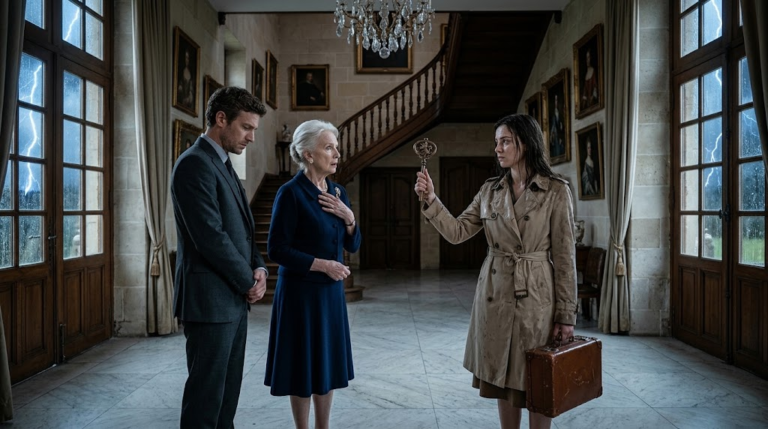
PART 1 — THE QUESTION MY FATHER SHOULDN’T HAVE ASKED
For eight months after my husband, Mark, and our seven-year-old daughter, Lily, died in a house fire, my parents barely called.
They hadn’t even come to the funeral.
My sister Rachel was getting married that weekend, and my parents said canceling the wedding would “destroy two families instead of one.”
So while I buried my husband and daughter, they watched Rachel walk down the aisle.
Afterward, there were no visits.
No birthday call.
No one asking whether I could sleep in an empty house without hearing Lily’s voice.
Then a newspaper published one headline:
WIDOW FILES $26 MILLION WRONGFUL-DEATH SUIT AGAINST HALE RESIDENTIAL, ALLEGING COMPANY KNEW OF ELECTRICAL FIRE RISK.
Hale Residential belonged to my sister’s new husband’s family.
Before I finished reading the article, my phone started ringing.
Mom.
Dad.
Rachel.
Then relatives who hadn’t spoken to me since the funeral.
I ignored every call.
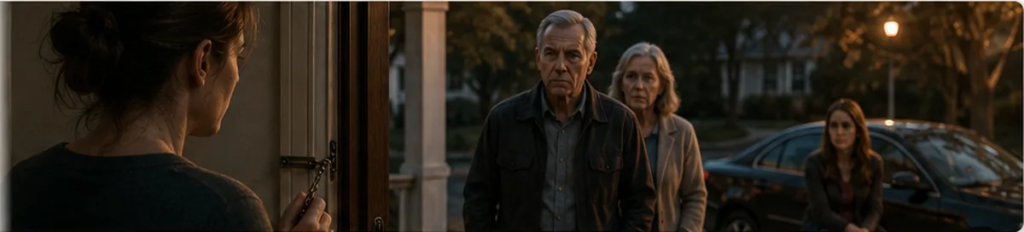
At 6:17 that evening, someone started pounding on my front door.
My father stood on the porch.
My mother was behind him.
Rachel sat in a car at the curb.
Eight months of silence.
One newspaper article had brought them to my house before dinner.
I opened the door but left the chain attached.
Dad’s first words weren’t about Mark.
They weren’t about Lily.
“You need to stop this lawsuit.”
“My daughter died in that house.”
“We know that.”
“And you’re worried about Rachel?”
Mom stepped closer.
“Andrew’s family could lose everything.”
And suddenly I remembered something from the night of the fire.
When I called my parents screaming that Mark and Lily were dead, my father hadn’t first asked what happened.
From somewhere behind my mother, I had heard him ask:
“Which house?”
At the time, I was too broken to understand why.
Now I looked directly at him.
“When did you first hear there was a problem with those electrical panels?”
Mom’s face changed.
Dad stopped talking.
Rachel finally climbed out of the car.
She wasn’t angry anymore.
She looked terrified.
I opened the door a little wider.
“Dad… did you know?”
Rachel answered before he could.
“He did.”
PART 2 — THREE WEEKS BEFORE THE FIRE
My mother whispered Rachel’s name like a warning.
But Rachel kept walking toward the porch.
“Tell her.”
Dad stared at the ground.
“Rachel, go home.”
“No.”
She looked at me.
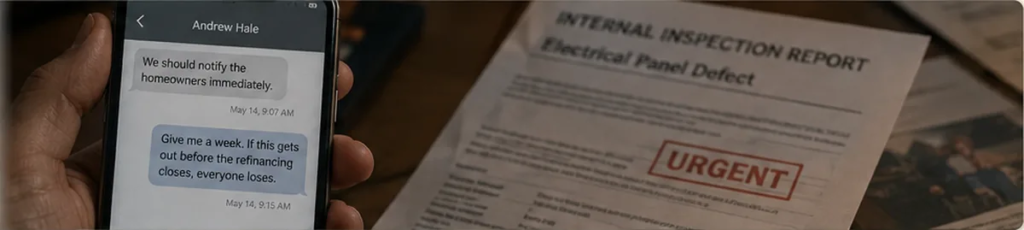
“Three weeks before the fire, Andrew told Dad about an internal inspection.”
My stomach tightened.
Hale Residential had discovered overheating inside a specific model of electrical panel installed in dozens of its houses.
Including mine.
The company’s engineers recommended an immediate inspection and replacement program.
But replacing every panel would cost millions.
“And Dad knew?”
Rachel nodded.
“Andrew showed him the report.”
I couldn’t understand.
“Why would Andrew show Dad?”
Nobody answered.
Then Dad finally said:
“Because I invested in the company.”
I stared at him.
Years earlier, Dad had quietly invested most of his retirement savings in Hale Residential.
When Rachel started dating Andrew Hale, the families became even closer.
If the defect became public, lawsuits could destroy the company.
And Dad’s investment with it.
“But you didn’t own the company,” I said. “You couldn’t stop them from warning people.”
“No.”
“Then what did you do?”
Rachel began crying.
Dad closed his eyes.
“I told Andrew’s father not to panic.”
That wasn’t enough.
I could see it on Rachel’s face.
“There’s something else.”
She reached into her bag.
Then she handed me an old phone.
“I found this after the wedding.”
There were screenshots of messages between Dad and Andrew’s father.
One was dated twenty-two days before the fire.
Andrew’s father had written:
We should notify the homeowners immediately.
Dad’s reply:
Give me a week. If this gets out before the refinancing closes, everyone loses.
I read it twice.
Then I looked at my father.
“You asked them to wait?”
“Only a week.”
“My daughter didn’t have a week.”
He had no answer.
But Rachel reached for the phone again.
“You haven’t seen the worst message.”
PART 3 — THEY HAD CALLED MY HOUSE

Rachel opened another screenshot.
This one wasn’t from Dad.
It was a company service log.
My address was listed near the top.
Three days before the fire, a Hale Residential electrician had flagged our house for an urgent inspection.
The note underneath read:
Resident contacted — no answer. Follow-up required.
I shook my head.
“That’s impossible. Nobody called me.”
Rachel swallowed.
“They didn’t call you.”
The emergency contact attached to our original purchase paperwork was my father.
He had helped Mark and me buy the house years earlier.
Hale Residential had called him.
Dad finally looked at me.
“I thought they were exaggerating.”
“What did they tell you?”
“That there might be an issue with the panel.”
“And?”
“I told them you were away.”
I felt the porch railing against my hand because suddenly I couldn’t feel my legs.
“We weren’t away.”
“I know.”
“You knew Lily slept upstairs.”
His voice cracked.
“I never thought the house would burn.”
That sentence destroyed whatever was left between us.
Not because Dad had started the fire.
He hadn’t.
But because someone had tried to warn us.
And he had decided the warning could wait.
Mom started crying.
“We already lost Mark and Lily. Do you really want Rachel to lose her husband too?”
I looked at her.
For eight months, I had wondered why my own mother could miss her granddaughter’s funeral.
Now I understood.
The wedding hadn’t simply been more important.
They had already known there could be a connection between the Hale family and the fire.
They had been protecting Rachel’s marriage from the beginning.
I closed the door.
The next morning, I gave Rachel’s phone to my attorney.
Two days later, Hale Residential offered to settle.
Twenty-six million dollars.
One condition:
Everything remained confidential.
My lawyer placed the agreement in front of me.
Then she slid a second document across the table.
“What’s this?”
“A subpoena response.”
Inside was an email sent the morning after the fire.
I recognized the sender immediately.
My mother.
And what she had written made Dad’s messages look almost innocent.
PART 4 — THE FUNERAL THEY CHOSE TO MISS
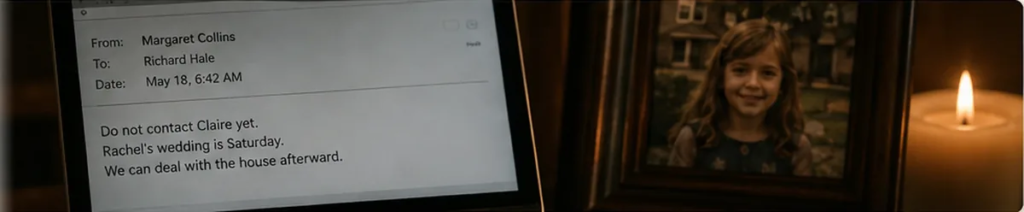
My mother’s email had been sent to Andrew’s father less than twelve hours after Mark and Lily died.
It contained only three sentences:
Do not contact Claire yet.
Rachel’s wedding is Saturday.
We can deal with the house afterward.
I stared at the screen.
That was why nobody came to the funeral.
They hadn’t been forced to choose between my grief and Rachel’s wedding.
They had made a calculated decision.
Keep me quiet.
Let the wedding happen.
Deal with the consequences afterward.
Except afterward, they never came.
Because as long as I believed the fire was an accident, there was nothing for them to explain.
I rejected the confidential settlement.
My attorneys amended the lawsuit using the internal inspection report, the service log, Dad’s messages and Mom’s email.
Hale Residential eventually agreed to a much larger settlement and a public safety program covering every home built with the affected panels.
Dad lost his investment.
Andrew’s father resigned.
Rachel separated from Andrew after learning he had known about the warning before their wedding.
My parents asked me to forgive them.
I never answered.
Months later, I stood outside the rebuilt elementary-school playground funded in Lily’s name.
There was a small plaque near the entrance.
Not about the lawsuit.
Not about the money.
Just Lily’s name and the years she had lived.
Seven years.
That was all she got.
My father had asked a company to wait one week.
My mother had asked them to wait until after a wedding.
And for the rest of my life, I would remember the simplest truth of all:
The people who claimed they were trying to save the family had decided which part of the family they could afford to lose.