PART 1
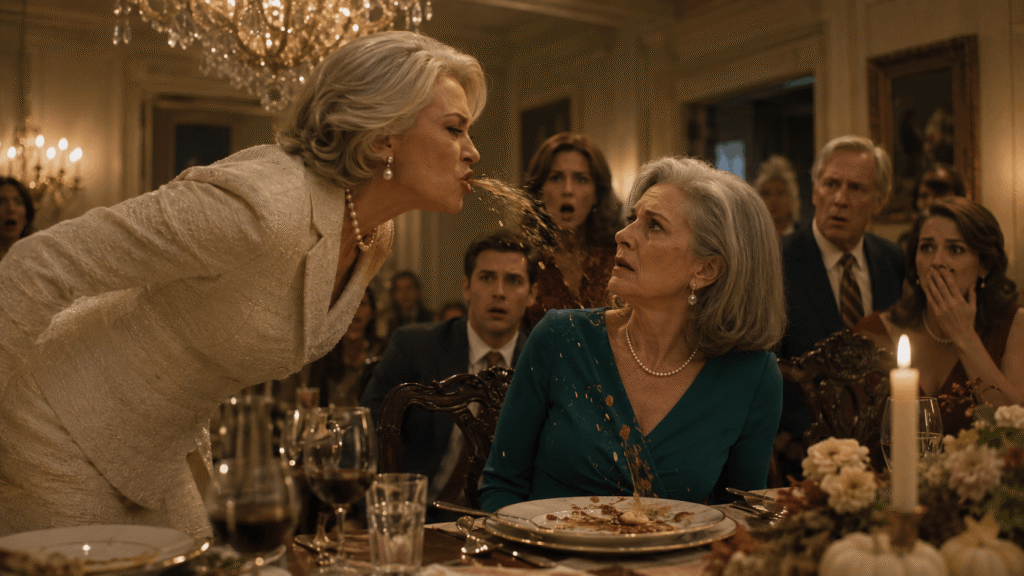
At dinner, my son’s mother-in-law spat onto my plate and said, “Old woman, this is exactly what you deserve.”
Fifteen people watched it happen.
Fifteen faces went still around the long mahogany dining table, forks suspended in midair and wine glasses trembling faintly in carefully manicured hands.
The Thanksgiving turkey remained untouched beneath the chandelier.
The embroidered tablecloth was flawless.
The porcelain was imported.
Even the silence felt expensive.
And at the center of it all was my plate, ruined by Laura Vanderbilt’s deliberate humiliation.
Laura, sixty-three, dressed in a pearl-colored Chanel suit, stood beside her chair like a queen who had just passed judgment on a servant.
Her diamond earrings caught the light as she looked down at me with a cold smile.
“This,” she said again, more quietly this time, “is exactly what you deserve.”
But what she had done to my plate was not what hurt the most.
What wounded me most deeply was my son.
Robert.
My only child.
The boy I had raised alone in Queens while cleaning houses during the day and sewing dresses late into the night.
He looked at me as though I were the one causing embarrassment.
Not Laura.
Not the woman who had just humiliated his mother in front of his entire in-law family.
Me.
Robert brought his hands together nervously, almost as though he were trying to calm an unruly stranger.
Then he leaned closer and whispered:
“Mom, please don’t make this any worse. Just behave yourself.”
Behave yourself.
For a moment, I saw him as a little boy again.
Sleeping beside my sewing machine while I worked until my fingertips were raw.
I remembered the secondhand suits I carefully altered so he could attend interviews in Manhattan.
I remembered missing meals so he could afford textbooks.
I remembered standing inside office restrooms at midnight, rubbing my aching knees and praying that one day my son would have a better life than I did.
And now he had that life.
Only he wasn’t standing beside me.
He was standing across from me.
Across the table, Valerie Vanderbilt Miller lowered her eyes and pretended she hadn’t seen anything.
Ernest Vanderbilt adjusted the expensive gold watch on his wrist.
Several cousins suddenly became fascinated by their phones.
An uncle stared at the ceiling.
Even the household employees remained motionless near the kitchen entrance.
Nobody defended me.
Nobody told Laura she had crossed a line.
Nobody even asked whether I was all right.
For years, I had quietly accepted smaller insults.
Valerie calling my sewing “humble.”
Laura hiding the carrot cake I had baked for our first meeting.
Robert seating me at a distant table during his Newport wedding.
My grandson, Matthew, being kept out of my arms as though affection from a grandmother without money could somehow contaminate him.
I always told myself that remaining silent was dignity.
That night, I finally understood something.
Silence can also be mistaken for permission.
I looked down at my plate.
Then I looked at Laura.
She expected tears.
She expected anger.
She expected me to apologize for ruining her perfect Thanksgiving.
Instead, I calmly lifted my linen napkin.
I wiped the corner of my mouth.
My hands didn’t shake.
Then I reached into my handbag.
I took out my phone.
And opened a message I had written three weeks earlier.
Three simple words.
“Put the plan into action.”
I pressed send.
Laura laughed.
Loudly.
Cruelly.
“Who are you messaging, Sophie?” she asked. “That little sewing group of yours? Are they going to rush over here and save you with thread and needles?”
Robert’s face suddenly lost color.
“Mom, please.”
I slowly stood.
The chair scraped against the polished floor.
Every person at the table turned toward me.
“My attorneys,” I said.
The laughter stopped.
Completely.
Laura’s smile vanished.
Ernest’s hand froze over his wineglass.
Valerie finally looked directly at me.
“What attorneys?” she asked.
I picked up my handbag.
“The ones you should have been worried about long before tonight.”
Laura scoffed.
“Oh, please.”
I looked at her.
“You have no idea what I’ve been doing while you were busy humiliating me.”
She folded her arms.
“You’re threatening us now?”
“No.”
I smiled.
“I’m informing you.”
Robert stood.
“Mom, what did you do?”
I turned toward him.
“Do you remember when you asked me to help you buy your first apartment?”
He nodded slowly.
“You said it was temporary.”
“Yes.”
“You promised every dollar would eventually be repaid.”
His eyes dropped.
“You never repaid it.”
“I know.”
“And when you wanted to start your investment company, who provided the seed money?”
Robert swallowed.
“You did.”
“And when Laura’s family insisted you needed a larger house?”
Silence.
I looked around the table.
“The down payment came from me too.”
Laura’s face tightened.
“That doesn’t give you the right to—”
“I haven’t finished.”
The room went quiet again.
I reached into my handbag and removed a thick black folder.
I placed it on the table.
The sound was surprisingly loud.
THUD.
Ernest stared at it.
“What is that?”
“Every loan agreement.”
Laura’s expression changed.
“Every transfer.”
Another document landed on the table.
“Every investment.”
Another.
“Every payment I made on behalf of Robert and Laura.”
Another.
“And every promise they made when they asked me for the money.”
Robert looked horrified.
“Mom…”
“You thought I didn’t keep records.”
I shook my head.
“I kept records because I spent forty years working with numbers.”
Laura suddenly laughed nervously.
“This is ridiculous. Those were family gifts.”
I looked directly into her eyes.
“Some were.”
Her smile returned for half a second.
Then I added:
“Some weren’t.”
The smile disappeared again.
I opened the folder.
“Remember the $480,000 I transferred for the townhouse?”
Robert’s face went pale.
“That was supposed to be an investment.”
“Correct.”
“I thought you gave it to us.”
“No.”
I slid a document across the table.
“You signed a repayment agreement.”
Robert stared at the page.
His mouth opened.
No words came out.
Laura grabbed it.
Her eyes moved rapidly over the document.
“No.”
She shook her head.
“No, this can’t be.”
“It can.”
“But you never asked us for repayment.”
“I didn’t need to.”
Laura looked at me suspiciously.
“Why?”
“Because I wasn’t planning to ask.”
She froze.
“Then what were you planning?”
I closed the folder.
“You’ll find out tomorrow.”
Ernest suddenly leaned forward.
“Mrs. Carter, if there is some misunderstanding—”
“There isn’t.”
His expression hardened.
“You should be careful about making accusations.”
I smiled politely.
“I haven’t made any accusations.”
I picked up my phone.
“My attorneys have.”
That sentence changed the atmosphere completely.
Valerie looked at her husband.
Ernest looked at Robert.
Robert looked at Laura.
And Laura finally looked afraid.
“Who are your attorneys?” she whispered.
I stood.
“Three firms.”
Her eyes widened.
“One handles financial litigation.”
I paused.
“One handles estate protection.”
Another pause.
“And the third handles the trust that will determine who receives my assets after I die.”
Robert’s face turned white.
“Mom…”
I looked at him.
“You were supposed to inherit everything.”
His eyes filled with shock.
“Was?”
“Yes.”
Laura suddenly stood.
“You can’t punish Robert because of me!”
I looked at her calmly.
“I’m not punishing him.”
“Then what are you doing?”
“I’m protecting myself.”
Nobody spoke.
I picked up my coat.
Then I leaned toward Robert.
“You spent your entire life believing I would always rescue you.”
His eyes filled with tears.
“I was wrong.”
I walked toward the front door.
Behind me, Laura shouted:
“You can’t just walk away!”
I stopped.
Then I turned around.
“Yes, I can.”
She stared at me.
I smiled.
“And tomorrow morning, you’ll understand exactly why.”
I walked out into the cold December night.
My driver was waiting at the curb.
I stepped into the car.
My phone buzzed before the door even closed.
A message from my attorney.
“Everything is ready.”
I looked at the screen.
Then I looked through the window at the enormous Vanderbilt estate glowing behind me.
For years, I had believed that family meant enduring anything.
That night, I finally understood the difference between family and exploitation.
And the next morning, when Laura discovered that the mansion she believed belonged to her family was connected to a trust she had never heard of…
she would learn that humiliating the wrong woman at Thanksgiving had been the most expensive mistake of her life.
PART 2

The next morning began with seventeen missed calls.
Nine from Robert.
Five from Laura.
Three from numbers I didn’t recognize.
I ignored every one of them.
Instead, I sat in the sunroom of my Connecticut estate, drinking tea and watching snow settle gently across the gardens.
At seventy years old, I had finally discovered something remarkable.
Peace.
At exactly 8:07 a.m., my attorney, Daniel Whitmore, arrived carrying a leather briefcase.
He looked pleased.
Very pleased.
“Good morning, Sophie.”
“That expression tells me something happened.”
Daniel set the briefcase on the table.
“Oh, something definitely happened.”
He opened a folder.
“The Vanderbilt family received formal notification at six o’clock this morning.”
I smiled.
“And?”
Daniel laughed.
“Laura apparently screamed so loudly that two household employees thought someone was having a medical emergency.”
For the first time in years, I genuinely laughed.
“What exactly upset her?”
Daniel slid several documents toward me.
“The trust.”
Of course.
The trust.
The one nobody knew existed.
Twenty-three years earlier, after receiving an inheritance from an elderly client whose life I had quietly helped manage, I made a decision.
I would never allow my life’s work to become someone else’s entitlement.
Every property.
Every investment.
Every account.
Everything had been placed inside a carefully structured trust.
A trust with conditions.
Specific conditions.
Conditions Robert had never bothered asking about because he assumed none existed.
Daniel tapped the first document.
“The Vanderbilt mansion sits on land partially controlled by a partnership tied to your trust.”
I nodded.
Laura’s family had always loved displaying wealth.
What they never understood was ownership.
There is a difference.
A very expensive difference.
“Keep going.”
Daniel turned another page.
“The annual operating loans for the estate.”
“Guaranteed by me.”
“Exactly.”
Another page.
“The private investment funds Ernest used to expand several businesses.”
“Also guaranteed by me.”
Daniel grinned.
“And the line of credit.”
“Also me.”
Daniel shook his head.
“I’ve never seen people live inside a financial structure they understood so poorly.”
Neither had I.
The Vanderbilt family believed they were powerful.
In reality, they had spent decades building their empire atop foundations I quietly reinforced.
Not because they deserved it.
Because Robert was involved.
My son.
My weakness.
The weakness that ended at Thanksgiving.
[Continued into Part 3…]
PART 3

Two days later, everything exploded.
Not financially.
Socially.
Because wealthy families have one weakness greater than money.
Reputation.
The story began spreading through Newport, Manhattan, Greenwich, and Palm Beach.
At first it was whispers.
Then rumors.
Then facts.
Laura Vanderbilt publicly humiliates elderly widow at Thanksgiving.
Financial dispute follows.
Trust documents emerge.
Potential litigation begins.
Suddenly everyone had questions.
Questions Laura couldn’t answer.
Questions Ernest couldn’t answer.
Questions Robert desperately wished nobody would ask.
By Friday afternoon, several board members resigned from charitable organizations connected to the family.
Not because crimes had occurred.
Because appearances mattered.
And appearances looked terrible.
Then came the video.
A household employee had captured part of the Thanksgiving incident on a phone.
Not the entire event.
Just enough.
Laura standing.
Laura speaking.
Laura humiliating me.
Laura laughing.
The video spread rapidly through private social circles.
The woman who spent decades presenting herself as elegance personified suddenly looked exactly like what she was.
A bully.
Then came the call from Valerie.
Not Laura.
Not Ernest.
Valerie.
Alone.
And for the first time in years, she finally apologized.
Not for one incident.
For all of it.
For every time she stayed silent.
For every insult she ignored.
For every moment she chose acceptance from her parents over decency toward me.
And somehow, that hurt more than Laura’s cruelty ever had.
Because cruelty is expected from cruel people.
Silence from family is harder to forgive.
Then she told me something I hadn’t heard in years.
“Matthew misses you.”
My grandson.
The boy who still kept the baseball glove I bought him.
The boy who asked why Grandma Sophie stopped visiting.
The boy who noticed my absence when no adult seemed to care.
For the first time since Thanksgiving, I cried.
Not because of Laura.
Because of Matthew.
PART 4
Three weeks later, I invited everyone to my house for Christmas Eve.
Robert.
Valerie.
Ernest.
Laura.
And Matthew.
Nobody understood why.
Especially Laura.
She arrived expecting another legal ambush.
Instead, she found a fire burning in the library and a grandmother hugging her grandson.
Matthew ran into my arms before anyone else crossed the threshold.
“Grandma Sophie!”
I held him tightly.
Longer than I intended.
Because some things matter more than pride.
Eventually everyone gathered in the library.
Nobody touched the drinks.
Nobody touched the food.
Everyone waited.
Finally Laura broke the silence.
“What is this about?”
I looked at her.
For the first time, I didn’t see an enemy.
I saw a frightened woman whose identity depended entirely on status.
And that status was slipping away.
“This is about ending something.”
I opened the black folder.
Everyone tensed.
Then I closed it again.
“I’m not here to destroy anyone.”
Shock crossed every face.
Including Laura’s.
“I spent weeks asking myself what I wanted,” I continued.
“And I realized I wanted accountability. Not revenge.”
The room became perfectly silent.
“Money can be repaid,” I said.
“Respect cannot.”
Nobody moved.
“Trust cannot.”
Still silence.
“Years cannot.”
Laura lowered her eyes.
For the first time.
Ever.
Then she began to cry.
Not gracefully.
Not dramatically.
Just honestly.
“I’m sorry.”
The words barely escaped her lips.
But they were real.
And everyone knew it.
Matthew looked around the room and asked the simplest question of the evening.
“So are we family again?”
Nobody answered immediately.
Because none of us deserved to answer that question yet.
Family isn’t money.
Family isn’t inheritance.
Family isn’t a mansion.
Family isn’t status.
Family is who stands beside you when doing so costs something.
At Thanksgiving, nobody had.
But Christmas Eve was different.
This time, they stayed.
They talked.
They listened.
They apologized.
They remembered.
And slowly, painfully, they began repairing what years of pride had broken.
Later that night, after everyone left, I stood by the window watching snow settle across the gardens.
My phone buzzed.
A message from Daniel.
“Everything resolved?”
I looked at the family photograph Matthew insisted we take before dinner.
Then I smiled.
And typed back:
“Not everything.”
“But it’s a beginning.”
Because in the end, Laura Vanderbilt learned something wealth could never teach her.
The most dangerous person in the room is not the loudest.
Not the richest.
Not the most connected.
It’s the quiet woman everyone mistakes for weak.
Especially when she has spent years keeping records.
And especially when she finally decides she has had enough.
THE END